
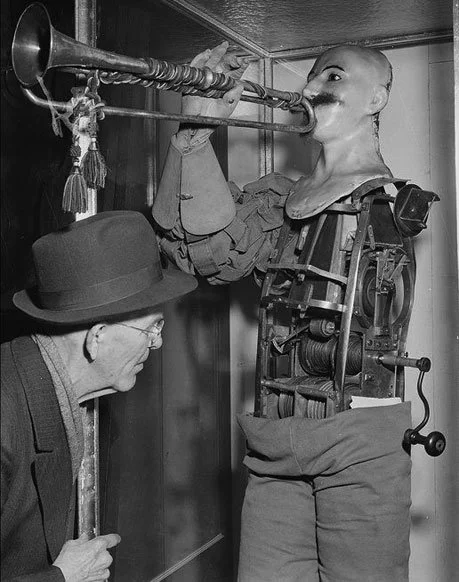
It sounds like a bulbous, multi-layered peeling vegetable, but this obscure mechanical musical instrument invented in 1812 in Dresden consisted of 24 trumpets and two kettle drums and, designed to mimic the sound of a marching band, might also make your eyes water. It was invented Johann and Friedrich Kaufmann. The Kaufmann family from Dresden in Saxony (clockmaker Johann Gottfried Kaufmann (1752-1818), his son Johann Friedrich Kaufmann (1785–1866), and his grandson Friedrich Theodor Kaufmann (1823–1872), became famous creating a variety of ingenious musical instruments at the beginning of the 19th century, and alongside the Belloneon, the Harmonichord (1810, attempting to fuse the piano and violin), Chordaulodion (1811), Acoustic Cabinet, and Trumpet Player automaton.
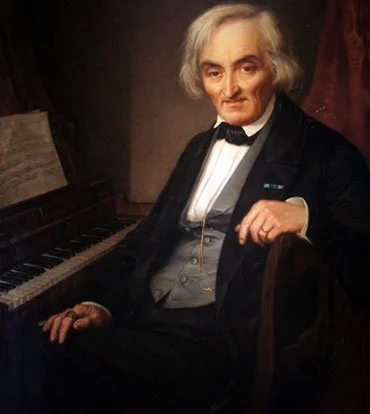
Johann Friedrich Kaufmann (1785–1866)
An 1817 issue of the American Monthly Magazine described a demonstration of Kaufmann’s musical machines, as follows:
"Messrs. Kaufmann, senior and junior, of Dresden, have exhibited four instruments composing an orchestra, which they call the Belloneon, the Cordelauidion, the Automaton Trumpeter, and the Harmonicord. The upper part of the Belloneon exhibits a trophy of arms, in the midst of which are placed twenty-four trumpets reversed: and the lower part encloses two kettle-drums with their sticks. It executes flourishes and marches, with extraordinary perfection. If it contained other wind instruments, it might be compared with Maelzel’s Panharmonicon, exhibited some time since in London and Paris.”
Unfortunately there is no image available of the Belloneon, so its cacophonous creation can only be left to the imagination, but the Trumpet Player automaton is shown above, inspected by an enthusiast in 1950, and this reverse image gives an idea of some the intricacies which would also been at play in the Belloneon.
The mechanism of the Trumpet Player is managed by means of two rotatable, mounted brass stepped drums. The notches mounted on the drums are in contact with 6 impacting tongues (pins) and four scanning levers, which activate wind valves, that let the air pass by 12 tongues, thus producing a sound, modulated through a trumpet, so it does sound like a trumpet. The stepped drum and the bellows are powered by a spring mechanism (two helical springs) that needs to be wound up, by the visible hand crank.
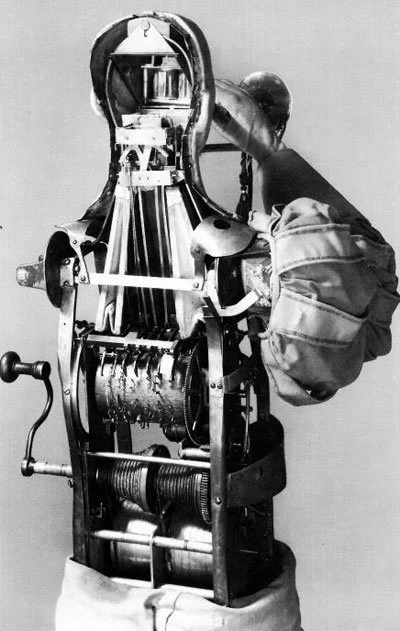
Trumpet Player automaton reverse side
So then, any further Bellonion- or Belloneon-related examples of multi-mechanical instruments from your own music library? Feel free also to share anything more in relation to it, whether in music or wider culture, such as from film, art, or other contexts, in comments below.
You can also get in touch the contact page, and also visit us on social media: Song Bar X, Song Bar Facebook. Song Bar YouTube. and Song Bar Instagram. Please subscribe, follow and share. New to comment? It is quick and easy. You just need to login to Disqus once. All is explained in About/FAQs ...
Song Bar is non-profit and is simply about sharing great music. We don’t do clickbait or advertisements. Please make any donation to help keep the Bar running: