
By The Landlord
“Methinks you are my glass, and not my brother: I see by you I am a sweet-faced youth.” – The Comedy of Errors, William Shakespeare
“And this is the catch-22 of confronting your doppelgänger: bark all you want, but you inevitably end up confronting yourself.” – Naomi Klein, Doppelganger: A Trip into the Mirror World
“When I was a kid I worried that when I woke up, I'd find my family having breakfast with my doppelgänger. We would fight to the death, and then my family would peacefully finish breakfast.” – Fran Krause
“Good people live honestly, good people live without falseness, and they never come in twos… For some seconds they both stood like that, motionless, with their eyes fixed on each other.” – Fyodor Dostoevsky, The Double
I have no twin, but then again, apparently I do. On more than one occasion, perhaps every couple of years, a friend, or even a stranger, has approached me, reporting a sighting of my apparent doppelgänger, someone of near-identical likeness in clothing, height and demeanour, in the same city, though in another location, at a recent time. Sometimes it turns out that that sighting was actually me, but mostly, it's my alleged mystery twin.
Have you ever heard about, or met yours? Even if our parents didn’t produce one, perhaps the chance intertwining of related genetics across billions of people could lead to a very similar result somewhere in the world. And after all, we are likely to be mostly cousins a few times removed.
But what’s just as fascinating is not merely the possibility, or the curiosity, but the emotional response of such a scenario. I'm intrigued, with a dash of vanity and narcissism, but also incredulity, dismissiveness, even mild horror. That’s impossible. You’re an imposter! There’s only one of me, isn’t there?
But what if there isn't? And what would they be like? Would we be close, and work as a great team, causing mischief and mayhem, becoming more than the sum of our parts, with a innate understanding, or knowing each other so well? Or being in competition, soon begin to undermine each other, and become mortal enemies? Or would the other actually be different inside, be distinctively better or worse, good, or evil, or just be like a clone, simply possess of all the same strengths and weaknesses, faults and behavioural traits, and so we'd just cancel each other out?
So then, this week we're all about twins in song lyrics, titles, or central ideas and stories, whether they are identical, or non-identical siblings, as well as the idea of the doppelgänger. And extending the idea further - twinning itself, linking people, such as stunt doubles, or objects, or even towns.
But on the sibling front, what must it be like to be a twin, especially identical? Common jokes and comments include that this allows you someone else to always take the blame, develop your own secret language, or spend life arguing about who is the original, and who is the remix.
Life is always a mix of nature and nurture, but physically and psychologically this must have a profound effect. At pregnancy, identical twins are monozygotic, meaning that they develop from one zygote, which splits and forms two embryos, while dizygotic ('non-identical' or 'fraternal'), meaning that each twin develops from a separate egg and each egg is fertilised by its own sperm cell. Identical twins are far more rare, usual only 3-4 per 1,000 births. The majority of twins are dixygotic, and while 25% Identical twins are the same gender, 50% tend to be a mix of brother and sister.
Whenever I meet twins, or parents of twins, I always ask the same question. Does the first born, even if by a few minutes, have a more dominant personality? It seems unlikely, but the answer almost always seems to be yes. I ask because have male and female twin cousins. She was born first by a few minutes, and has always been a more extrovert. They get on very well with each other, but they they were babies, on one occasion she apparently pushed him out of the pram.
Twins have also become more common across the world, partly due to infant survival rate, but sometimes for other reasons. Astonishingly human twin birth rate, for example, in the United States rose 76% from 1980 to 2009, from 9.4 to 16.7 twin sets (18.8 to 33.3 twins) per 1,000 births. But there are some unusual patterns elsewhere. The Yoruba people, an ethnicity of West Africa including Nigeria, Benin and Togo, have the highest rate of twinning in the world, at 45–50 twin sets (90–100 twins) per 1,000 live births, and this is thought to be connected to a high consumption of a specific type of yam containing a natural phytoestrogen which may stimulate the ovaries to release an egg from each side.
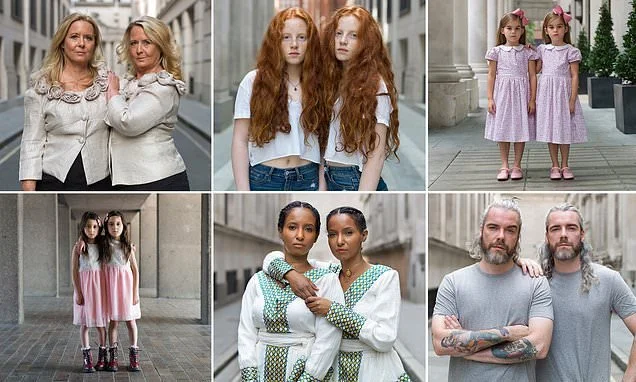
Peter Zelewiski twin portraits
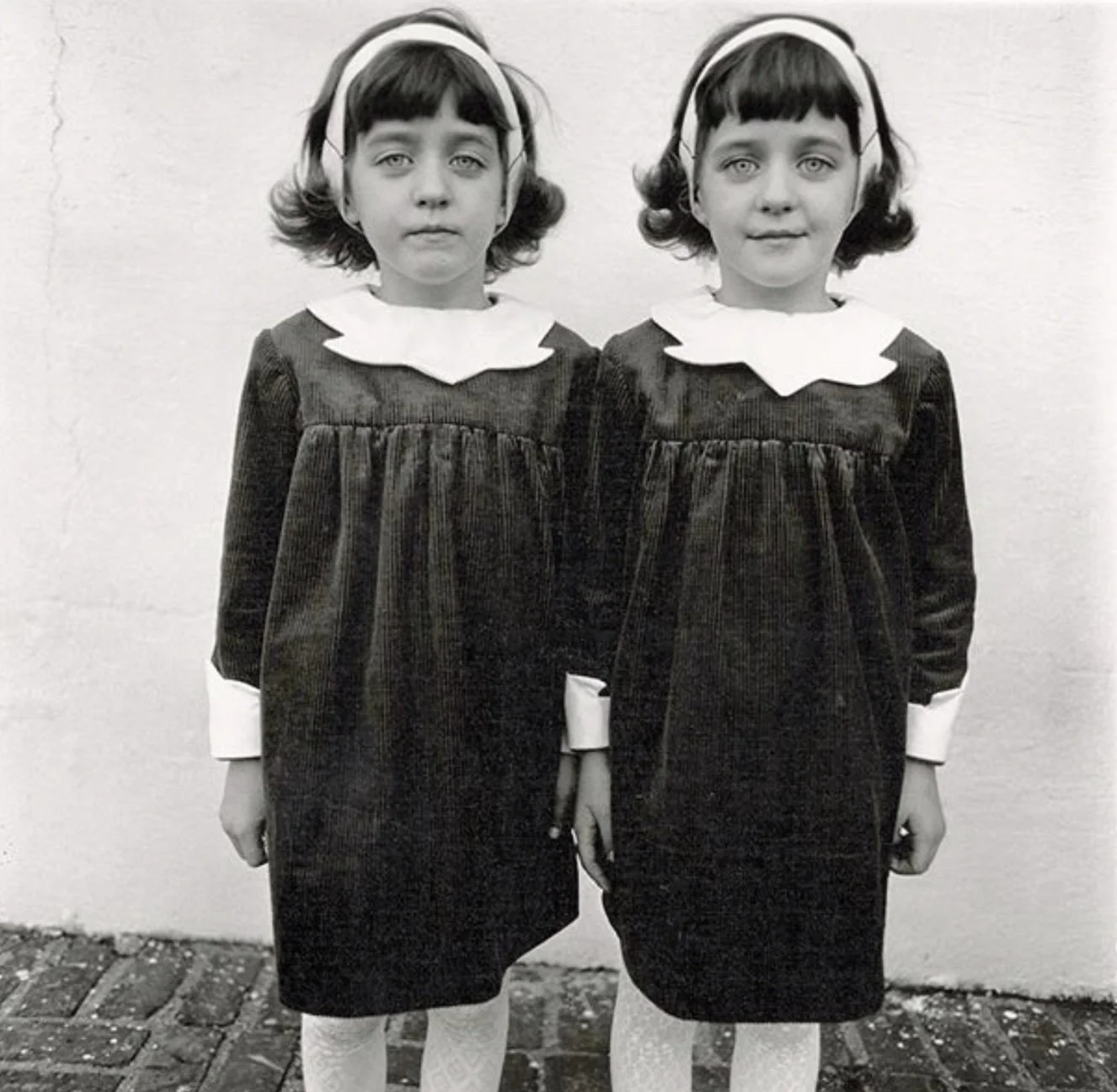
Identical twins by Diane Arbus

Thorunn and Jorunn from Reykjavík, 1969
Identical twins are thought to develop conventional language slower than other children, because of the communication they develop between themselves, but like musicians, quickly develop an innate mutual understanding. There are dozens of successful twin musical acts, but is that for psychological reasons, or because of their visual appeal?
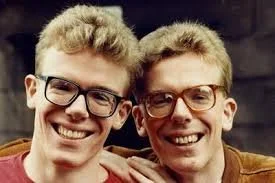
Take a look … Craig and Charlie, aka The Proclaimers
The answer is a mix of course. The Bee Gee brothers were innately musical, inherited from their jobbing musician father, but within that creative mix, Maurice and Robin Gibb were non-identical twins, as younger brothers to Barry. On the identical twins in music front, we might instantly think of Craig and Charlie of The Proclaimers, or Orange County experimental rockers The Garden, featuring twins Wyatt and Fletcher Shears, or Canadian indie rockers Tegan and Sara, the London-based indie-pop act Tall Poppies with identical twins Susan and Catherine, or the more novelty act, Romanian twins Gabriela and Monica Irimia, aka The Cheeky Girls.
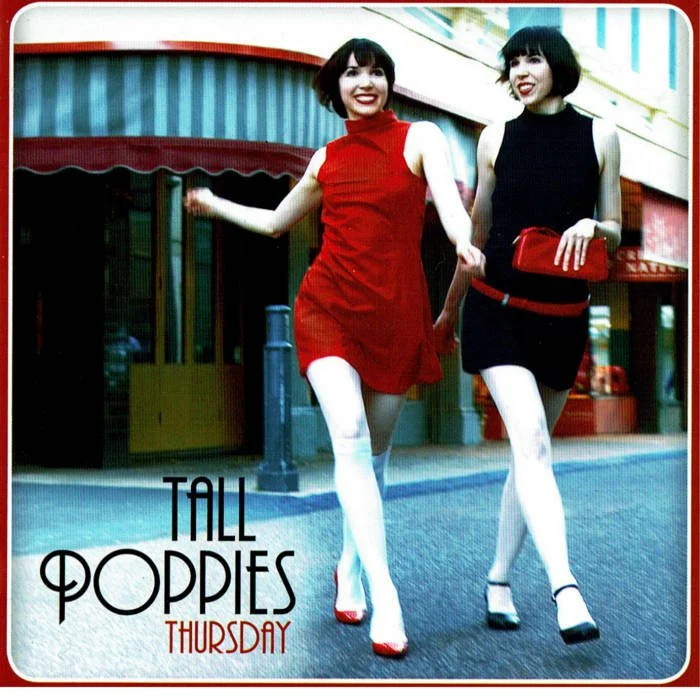
London based Australian twins Susan and Catherine, and their band Tall Poppies
All of these siblings have had various levels of success, and have enjoyed and chosen to write and perform together. But some twins music’s oddball history began in exploitation, especially when there’s an extra element to their connectedness. There are many examples, but among the most extraordinary were originally slaves, who eventually gained freedom and success Millie and Christine McKoy (July 11, 1851 – October 8, 1912), were African-American pygopagus conjoined twins who variously went by the stage names "The United African Twins"[1]: 125 "The Carolina Twins", "The Two-Headed Nightingale" and "The Eighth Wonder of the World". While ruthlessly exploited and kidnapped and often displayed as freaks, they became a renewed singing and piano harmonising duo and performed in front of Queen Victoria and learned five languages.
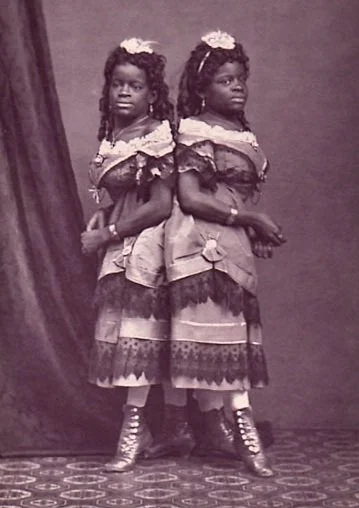
Millie and Christine McKoy
Their motto was "As God decreed, we agreed. As toddlers it’s reported that they were clumsy and fell down quite frequently. They eventually developed a sideways walk that turned into a crowd-pleasing dance style as well as their music. On 8 October 1912, Millie and Christine died at the age 61 of tuberculosis. Christine died 12 hours after her sister. They were buried in an unmarked grave, but in 1969 they were moved to a cemetery in Whiteville, and engraved on their tombstone were these words: "A soul with two thoughts. Two hearts that beat as one.”
Songs actually by twins or indeed siblings, are for another time, as this week’s topic is about them. But twins also have a rich presence in mythology as well as literature and popular culture, from Greek twins Castor and Pollux (Dioscuri), the Roman found twins Romulus and Remus, and the Hindu Krishna and Balarama. And in another context, there’s Hergé’s Tintin stories, featuring the twins Thompson and Thomson, who strictly speaking aren’t twins, but nearly identical.These names and others might also come up in song lyrics.
The doppelgänger is the twin, welcome or otherwise, met later than birth, and can also have deep psychological consequences and they can be the same or the opposite as the ‘original’. There are also many books on that subject. In Edgar Allan Poe's 1839 short story William Wilson the main character is followed by a doppelgänger his whole life, with it troubling him and causing mischief. Eventually the main character kills his doppelgänger, and realises that the doppelgänger was only mirroring him.
Better known and with a different take, Fyodor Dostoyevsky's 1846 novel The Double is a disturbing, nightmarish scenario which presents the doppelgänger as an opposite personality who exploits the character failings of the protagonist to take over his life. It’s a story often repeated in other books, as well as films.
Identical twins meanwhile have also been a rich source of film plot twists. David Cronenberg 1988 psychological thriller Dead Ringers is a disturbing release starring Jeremy Irons as the clinically clever dual role as identical twin gynecologists, one broadly evil and exploitative, the other his victim. There’s also an intriguing and entertaining 2022 TV series of the same story by Alice Birch starring Rachel Weisz as Beverly and Elliot Mantle, the gender-flipped versions of the Jeremy Irons characters.
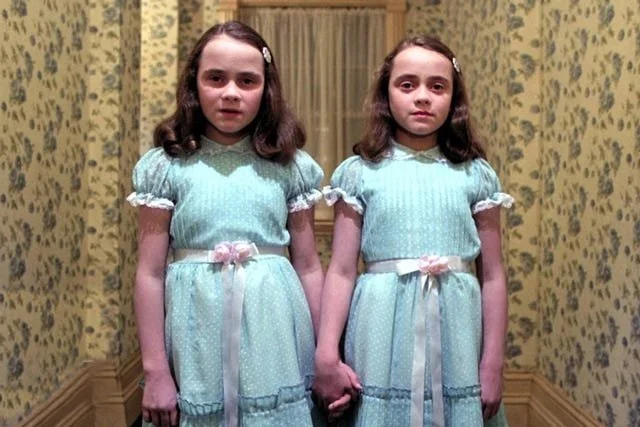
But if you want even more disturbing, is there anything more so than the twins Alexa and Alexie Grady, played by Lisa and Louise Burns, encountered by Danny in Stanley Kubrick’s The Shining? No matter the context, twins are always mesmerising …
But in real life, let’s close with the extraordinary documentary Three Identical Strangers (2018), which more than doubles the twin effect, telling the story of not twins, but identical triplets, three boys separated at birth who discovered one another by chance in New York in 1980 at age 19, uncovering dark reasons why they were all separated, unleashing joy and tragedy at their reunification, and profound revelations about human nature and how an upbringing can have just as much effect as your genes.
So then, it’s time to play with the twins. Will there be double the trouble, or twice the joy? This week’s nurturing doubly good playlist expert is Marco den Ouden! Place your songs in comments below, for deadline at 11pm UK time on Monday, and playlists published next week. Two is better than one .. mostly.
New to comment? It is quick and easy. You just need to login to Disqus once. All is explained in About/FAQs ...
Fancy a turn behind the pumps at The Song Bar? Care to choose a playlist from songs nominated and write something about it? Then feel free to contact The Song Bar here, or try the usual email address. Also please follow us social media: Song Bar X, Song Bar Facebook. Song Bar YouTube, and Song Bar Instagram. Please subscribe, follow and share.
Song Bar is non-profit and is simply about sharing great music. We don’t do clickbait or advertisements. Please make any donation to help keep the Bar running.