
By The Landlord
“Where shall we three meet again in thunder, lightning, or in rain? When the hurlyburly 's done, when the battle's lost and won.” – William Shakespeare, Macbeth
“Thunder is good, thunder is impressive; but it is lightning that does the work.” – Mark Twain
“Across the Bay, lightning walked on awkward stilts” – Graham Masterton, Charnel House
“Electricity is really just organised lightning.” – George Carlin
“Death is the sound of distant thunder at a picnic.” – W. H. Auden
“A poet is someone who stands outside in the rain hoping to be struck by lightning.” – James Dickey
“A song is an emotional lightning bolt.” – Mary Gauthier
It suddenly arrived yesterday afternoon, unforecasted, as the sweaty city summer humidity intensified. The air seemed to tingle, silently crackle, and the sky turned a bruised and broody pinkish grey. At the time I was swimming outdoors in a municipal reservoir, a regular and welcome stress-relieving pastime, especially during the heat of the summer. But just as I was getting up some swishy momentum, the on-duty lifeguard in a kayak suddenly appeared, telling everyone, with a calm urgency, to get out of the water. And so, like clumsy, slow fish, all chasing some distant breadcrumbs, we splashed to the shore, ripples of childlike fear and excitement uniting us, almost as if a shark was at large, or perhaps more precisely some big electric eel.
As us swimmers began changing on the outside wooden decking, sure enough there was, as predicted, a faint flash in the distance and then a few seconds later, that satisfying, if a little subdued, low rumble, followed by a sudden breeze. Then, slowly at first, a slight trickle of rain, which increased as we scuttled for shelter. The whole episode lasted for about 30 minutes.
It's a natural phenomenon that's been around far longer than humans, but it's hard, even now, not to feel fascinated by the sight, sound and feel of thunder and lightning. It brings people together. As a child that powerful, unseen rumble summoned in my electrified imagination images of a giant in the sky, deciding to try out his heavy roller skates on a big, grey slab of slightly bumpy celestial concrete.
So then, this is a song topic that, when the thought first struck me, I'd imagine it has surely hit the same place before. Surprisingly not. Yes, the more general ones of rain and storms have, in the distant past elsewhere, but when it comes wet weather, thunder and lightning are the leading characters in such scenarios, and you can't have one without the other. Whether in descriptions of one, both, actual or metaphorical, songs which use them as a central or prominent lyrical theme, and perhaps also express them in music or sound effects might strike as relevant.
Thunder and lightning may be a backdrop, or an expression of stormy relationships, a high charge of emotions, or of inspiration, change, turmoil or chaos, but it can also be comforting state, one that, when under shelter expresses a sense of cosiness or release, or of a common, shared experience.
Technically, thunder is caused by lightning. But thunder arrives later because the sound travels far slower than light. They are like a pair of performers, the first announcing the other on to the stage, and yet the announcer is a far bigger star, because thunder is really just sound of, and applause for, lightning.
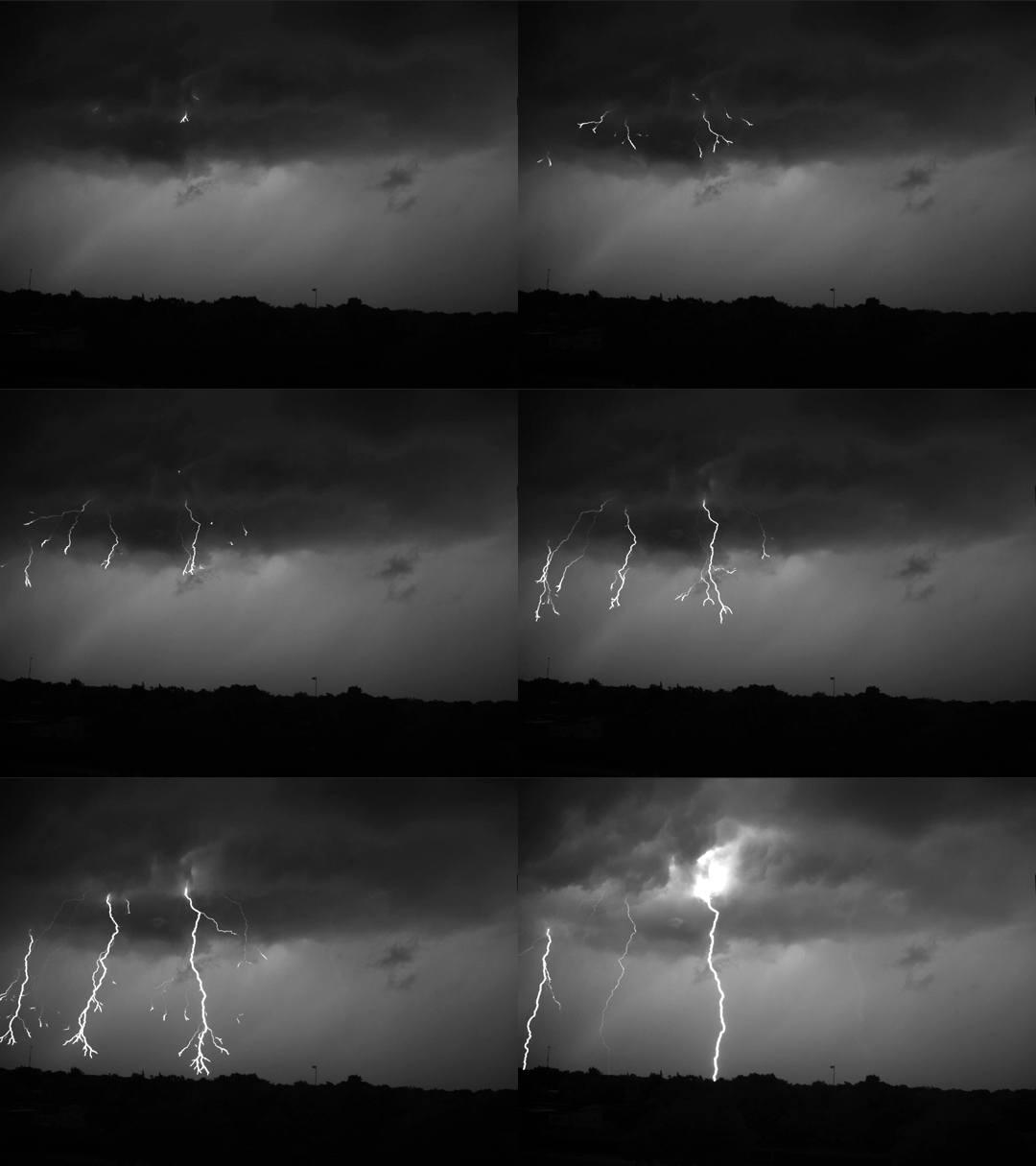
So then, some science. Lightning usually occurs when warm and cold air fronts intermingle, bringing electrostatic discharges moving through the atmosphere between two electrically charged regions, sometimes within a cloud, or between clouds, or from cloud to ground or water, the last of which is also known as a lightning strike. Lightning involves a near-instantaneous release of energy on a scale averaging between 200 megajoules and 7 gigajoules, the air around the lightning flash rapidly heats to temperatures of about 30,000C (54,000F) or five times hotter than the surface of the Sun. which is hard to fathom, but it's all over in an instant, unless of course you are unlucky enough to be struck by it, the chances of which are very low indeed. Having said that, according to the Met Office, there are still an estimated 44 strikes hitting the Earth every second. And a lightning bolt is on average 2-3 miles long, or an inch (2-3cm) or wide, about the same as your thumb. That’s one very hot digit.
In cloud-to-ground strikes, most involve a negative charge is transferred downwards, but in about 5% of cases vice versa positive charge, often involving a far more powerful strike. It must seek out the nearest point of discharge whether that's a tall building such as a skyscraper or church, a tree, or even a person or animal. Equipped like most buildings with a lightning conductor, New York's Empire State building, for example, is struck by lightning on average 23 times per year.
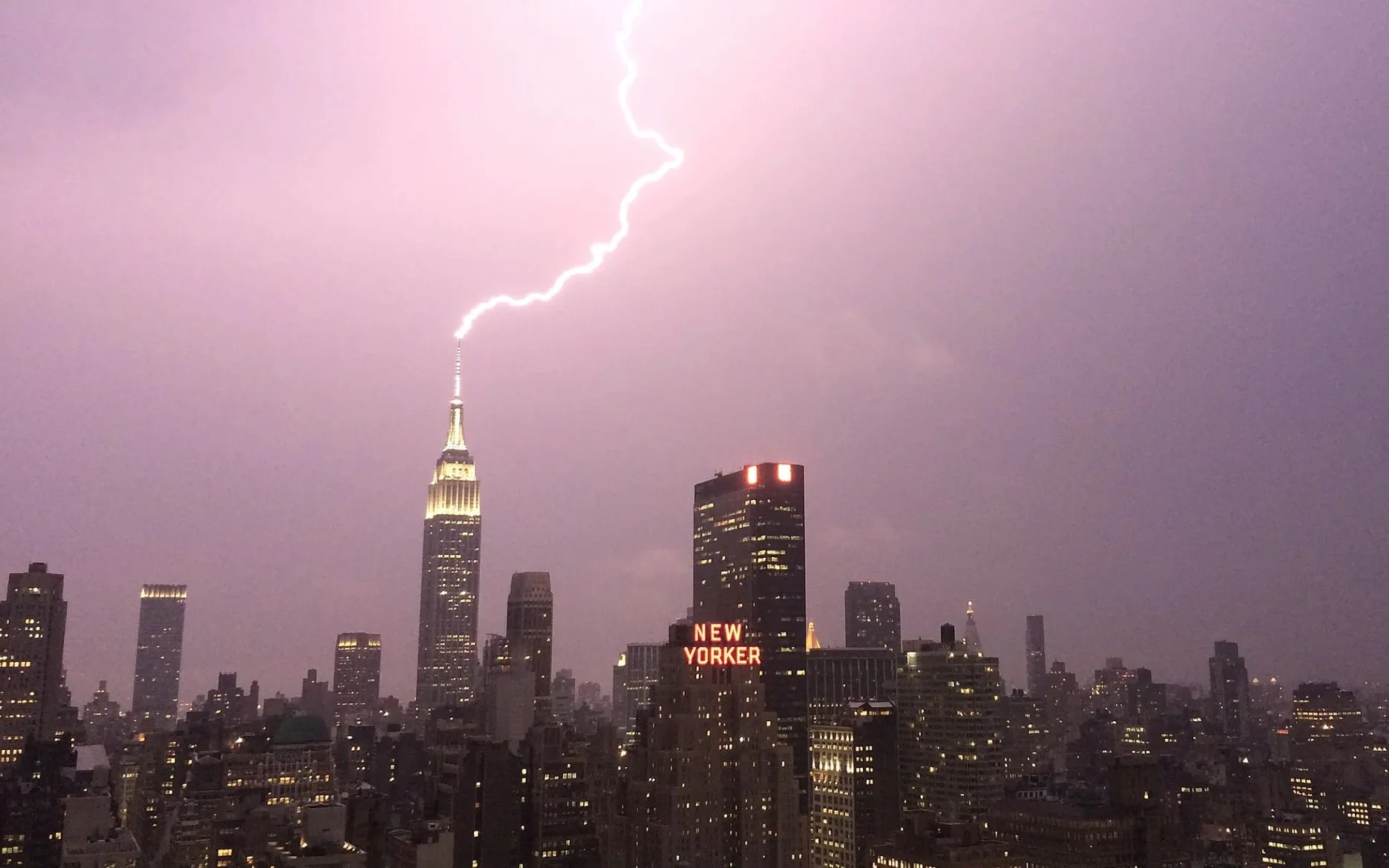
New York’s Empire State Building is a striking place
But that’s nothing compared to Lake Maracaibo in Venezuela, Earth’s number one hotspot for lightning strikes, the centrepoin for enormous thunderstoms 140-160 nights per year with an average of 28 lightning strikes per minute lasting up to 10 hours at a time, averaging 40,000 lightning strikes in one night. Catatumbo lightning, as it is called in the region, and Catatumbo means "House of Thunder" in the language of the Bari people. If you want to see lightning, that’s the place to go, but be careful with that metal spiked umbrella…
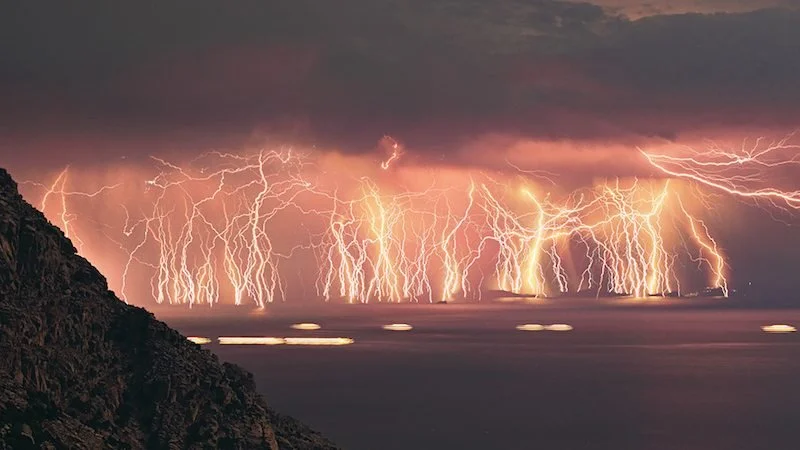
Catatumbo lightning
It's no wonder that before scientists, such as Benjamin Franklin, who installed a lightning bell detector at the top of his house in the mid-18th century, lightning has been associated with an act of divine intervention or anger - such as the Greek god Zeus, the Aztec god Tlaloc, the Mayan God K, Slavic mythology's Perun, the Baltic Pērkons/Perkūnas, Thor in Norse mythology, Ukko in Finnish mythology, the Hindu god Indra, the Yoruba god Sango, Illapa in Inca mythology and the Shinto god Raijin.
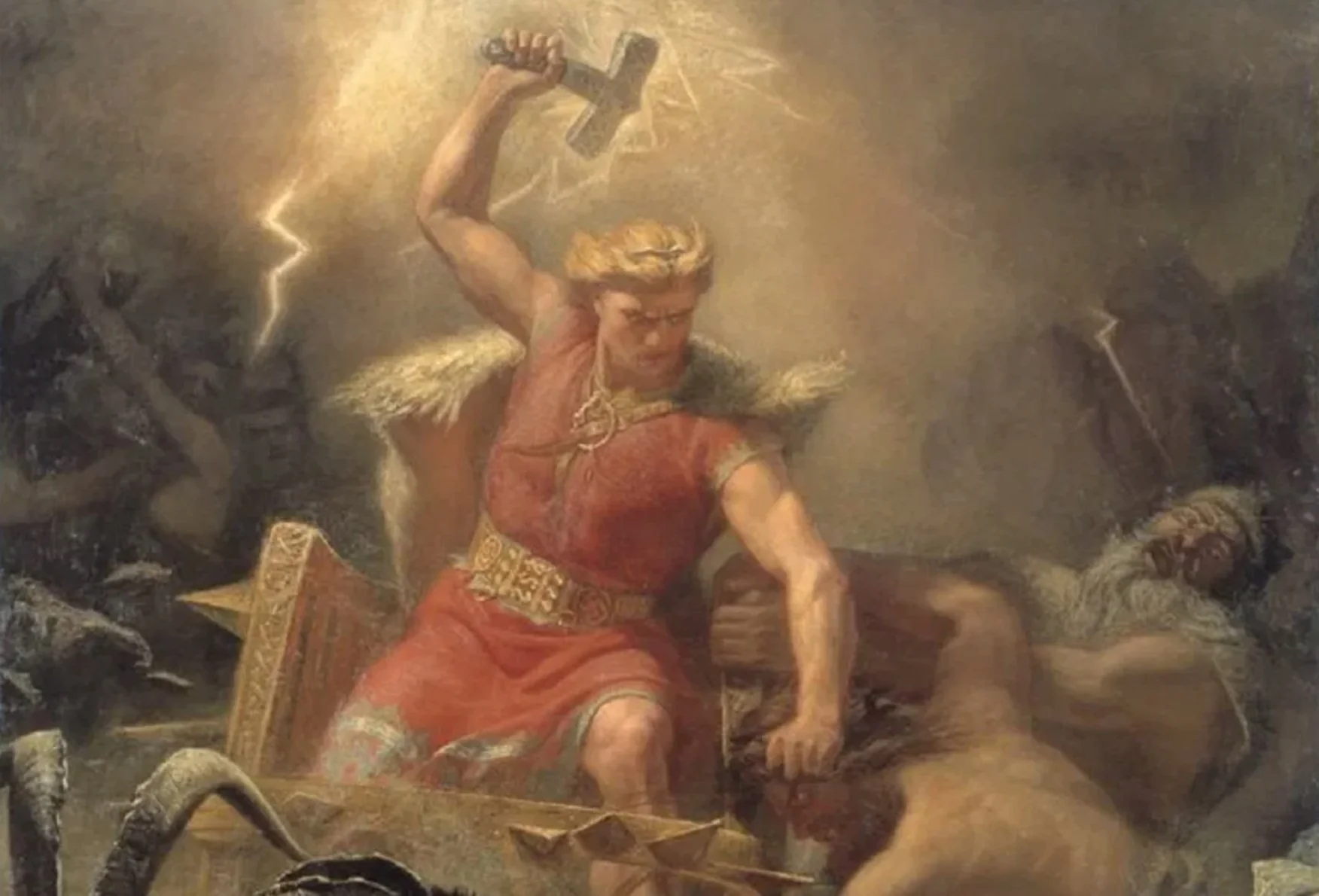
Norse god Thor battles giants with his classic weather weapon hammer
Thunder then, is not a separate entity but the sound caused by lightning, arriving later, expressing the sudden increase in temperature and hence pressure from rapid expansion of the air in the path of a lightning bolt. It might come as a loud clap, or crack, or rumble. The study of thunder is known as brontology and the fear of it brontophobia, which to me also summons images of a large, plant eating, bellowing dinosaur.
Thunder, in theory happens exactly at the same time as lightning, but it's speed through air which makes the difference. LIght travels at 299,792,458 metres per second, while sound moves at a mere, but still at a whopping 343 metres per second. In practical terms, from the moment you see lightning, a traditional method is to begin counting seconds ("one elephant, two elephant" etc), which amounts to kilometre away for every 3 seconds or 1 mile every 5 seconds.
But sometimes, the lightning might be far nearer and the sound therefore arrive almost immediately, with what coud be a clicking or cloth-tearing sound, then a cannon shot sound or loud crack/snap.
However it is seen or heard, it is certainly a common rod for writers of song or any other genre. "Creativity hits me like a lightning bolt. For two weeks ideas overflow and spill from me, before a period of nothing. The prospect of it suddenly just leaving me one day scares me. I'm terrified that every song I write might be my last," cries out Arlo Parks, who was listed in our recent generations topic, in the throes of worrying about the next release. But in the meantime there are many other artists to consider with this topic as we step outside to see nature's meteorological fireworks.
So then, it's time to bring a clap and a spark with your thunder and lightning song suggestions. Who will be this week's Thor or other god of playlists? This week’s lightning conductor and musical meteorologist is the excellent ajostu. Deadline for song suggestions is 11pm on Monday UK time, for results out next week. Maybe it'll all come in a flash.
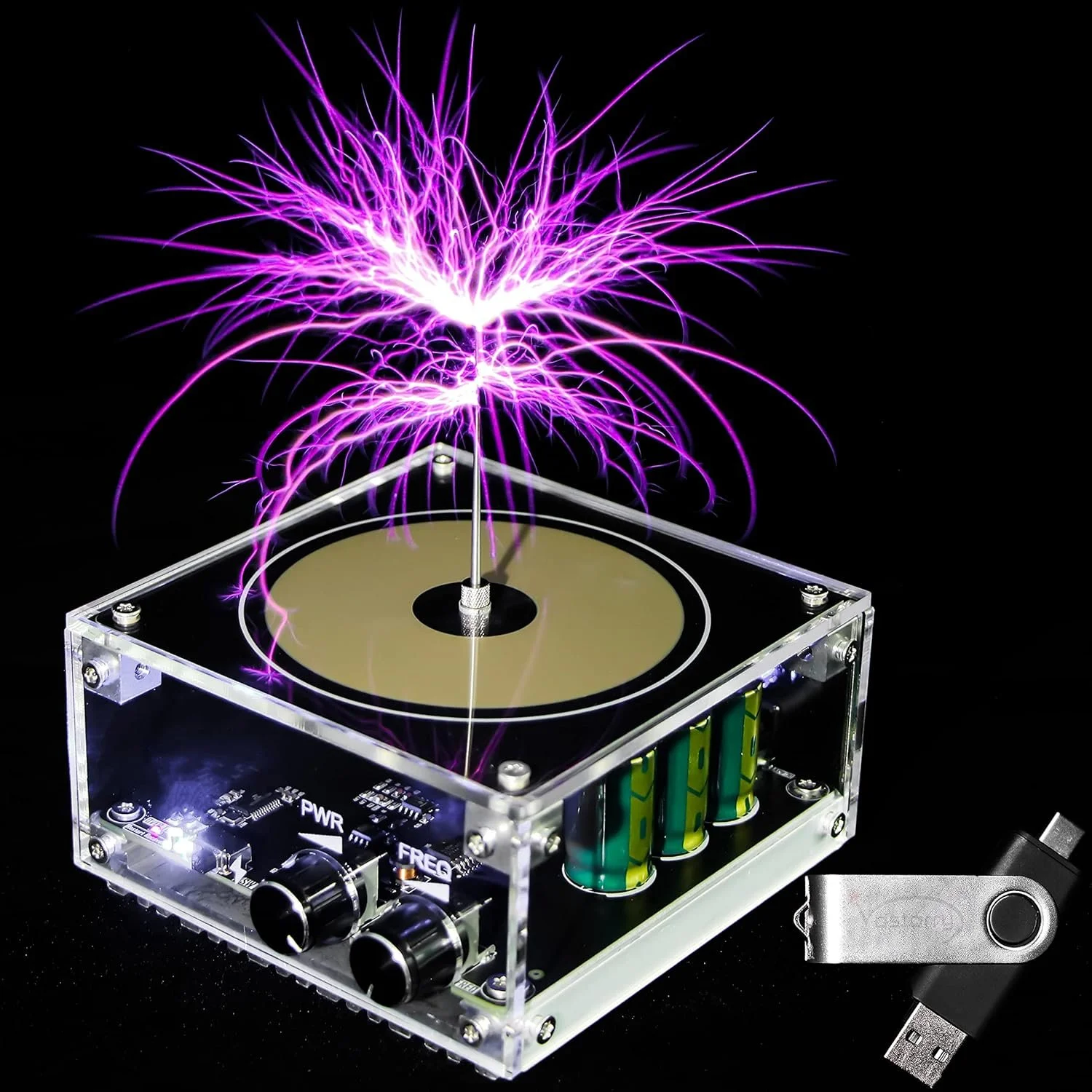
Musical lightning maker …
New to comment? It is quick and easy. You just need to login to Disqus once. All is explained in About/FAQs ...
Fancy a turn behind the pumps at The Song Bar? Care to choose a playlist from songs nominated and write something about it? Then feel free to contact The Song Bar here, or try the usual email address. Also please follow us social media: Song Bar X, Song Bar Facebook. Song Bar YouTube, and Song Bar Instagram. Please subscribe, follow and share.
Song Bar is non-profit and is simply about sharing great music. We don’t do clickbait or advertisements. Please make any donation to help keep the Bar running.