By The Landlord
“I don't need time. What I need is a deadline!” – Duke Ellington
“I love deadlines. I love the whooshing noise they make as they go by.” – Douglas Adams, The Salmon of Doubt: Hitchhiking the Galaxy One Last Time
“ULTIMATUM, n. In diplomacy, a last demand before resorting to concessions.” – Ambrose Bierce
“The only time I ever iron the sheets or make meringues is when there is an ... urgent deadline in the offing.” – Angela Carter
“Deadlines are things that we pass through on the way to finishing.” – Peter Gabriel
“I am one of those people who thrive on deadlines. Nothing brings on inspiration more readily than desperation.” – Harry Shearer
“The needs of the nation are not necessarily convergent with the needs of the deadline satirist.” – Christopher Buckley
“A poem is never finished, only abandoned.” – WH Auden
“You've got a deadline. Well, I do, too: death.” – Leonard Cohen
I'm always trying to work on one, so today I'm working on what is a meta-topic. The clock is ticking down past Thursday lunchtime ...
They are imposed upon us from early life. Getting dressed to go to school. Rushing to be at work on time. Working towards the sound of a classroom bell, an exam time limit, or a departure time. Finishing that project that’s suddenly on horizon and is no longer a shifting rainbow. It's a mix of vital public and personal motivation, and yet is also part of mass illusion and part of a cultural zeitgeist.
So this week it's all about those pressured time-related signposts, self-imposed or put upon others, as expressed in song, as the primary focus of lyrics. They might be about finishing something or getting somewhere within a certain period. Or giving an ultimatum to another person about completion. Or how things must change, tasks or behaviour. Or it could be a bigger political or diplomatic one.
It's a key part of human behaviour. It’s trick we play upon ourselves or others. Deadlines and ultimatums come in many contexts, and inspire a range of nuance and emotions.
But there's a paradox about deadlines, and even ultimatums, because can they ever really be absolute? Arguably a deadline could be caught up in Greek philosopher Xeno's dichotomy paradox, also expressed as the metaphor and tale of Achilles and the tortoise or the flying arrow, because as recounted by Aristotle in volume VI of his Physics: "That which is in locomotion must arrive at the half-way stage before it arrives at the goal.”
So in other words whether it is speedily Achilles rapidly catching up with that slow walking creature, even though he is going so much faster, or an arrow, to get there, each halfway point is always divided in two, so in theory all remain constantly in motion, ad infinitum and never get to the end point.
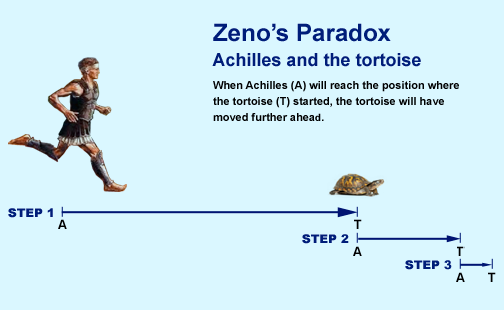
Shifting deadlines, paradox style …
TWO HOURS TO GO:
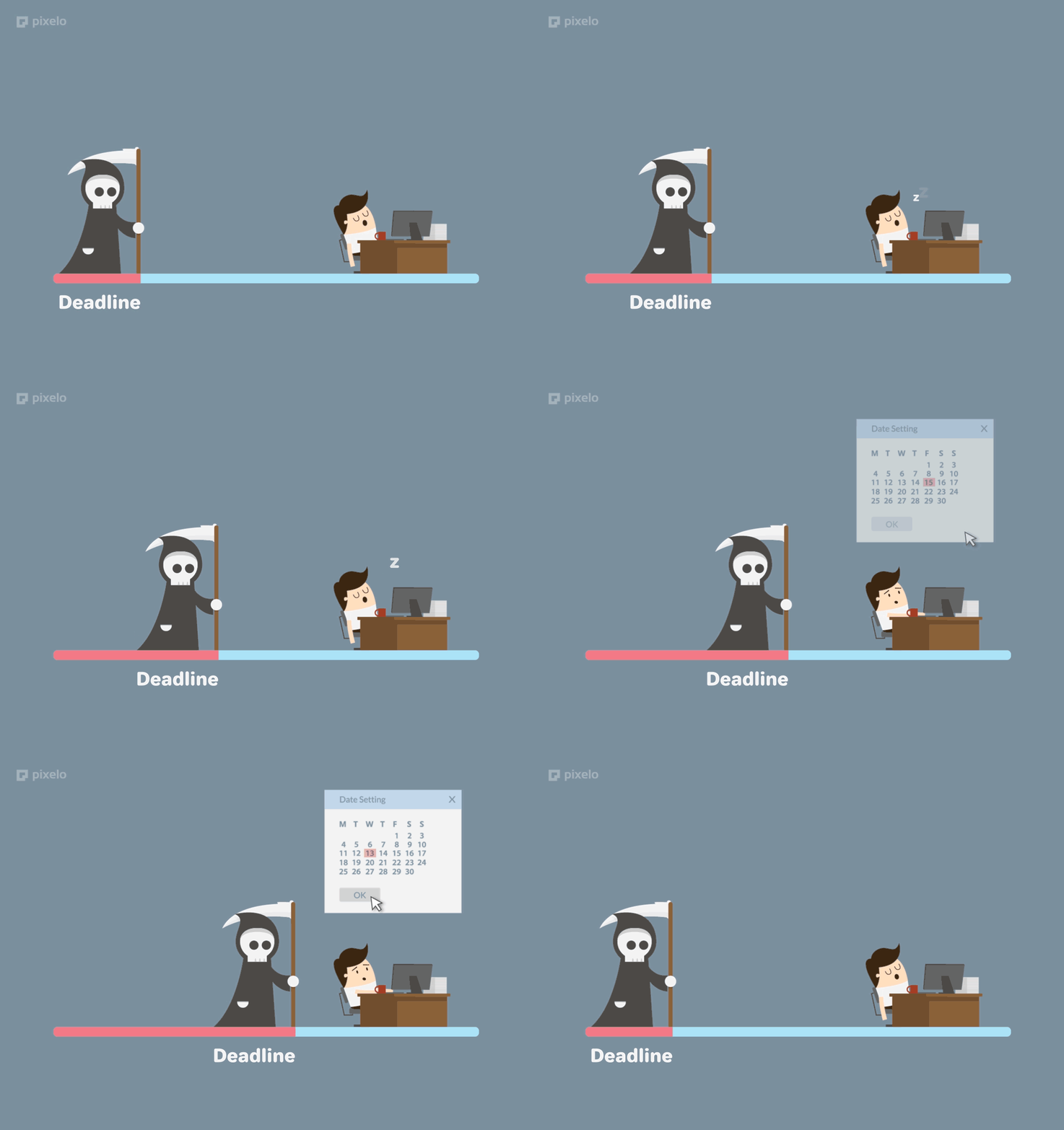
That said, in reality, deadlines do actually arrive. But invariably then another appears on the horizon. In local council politics it's also called kicking it into the long grass. Many people make a career of it – the office politics of the appearance of working towards a goal, of meta-work noise. Sometimes though, deadlines really are a matter of life and death (such as in a hospital), but mainly they are a watery and in constant movement, a perception in the greater pattern of life, that is, until the ultimate deadline we all prefer not to think about.
And while deadlines get us into a sweat, and certainly focus the mind and do get things finished (or at least compromised and abandoned as WH Auden put it above in his reference to the French poet Paul Valéry) there's another paradox at play here. Any piece of work, perhaps an album, a book, a film, or maybe even completed building, if it's something you admire, enjoy and return to, including songs nominated here, all were created and resulted in an intense pressure to be finished, but at a later date, who is thinking about that original deadline imposed by editors, bosses, producers or sponsors? It is entirely forgotten. The deadline simply melts into irrelevance and fades into the past.
As George R. R. Martin, author of the Game of Thrones TV series books puts it: "If the novels are still being read in 50 years, no one is ever going to say: 'What's great about that sixth book is that he met his deadline!' It will be about how the whole thing stands up."
Some acclaimed releases however have been famously the result to a series of broken deadlines. The landmark second album by My Bloody Valentine, Loveless (1991), was recorded of a painstaking period of almost three years, prolonged by (and I have first-hand knowledge of this from one of its key members) the band living an extremely procrastinatory and stoned existence in the same house, but most of all by the painstaking and meticulous approach of Kevin Shields' perfectionism and experimentation across 19 different studios, resulting in a final production cost that was rumoured to have reached £250,000, which nearly bankrupted their label, Creation Records.
In another genre, and another timescale, the appropriately titled The Other Side of the Wind (2018) a posthumous release written and directed by Orson Welles, had so many setbacks and deadline changes that it took almost 48 years from start to eventual release.
Francis Ford Coppola's Apocalypse Now is of course universally acclaimed, but had so many setbacks from cast changes and conflicts to weather-related disasters, he declared that: 'Vietnam was insane, Apocalypse Now only slightly less so".
His wife Eleanor Coppola co-created this documentary about the making of the film, Hearts of Darkness: A Filmmaker's Apocalypse.
So then, after many ups and downs, Rome wasn't built in a day. That’s a which originated as a medieval French proverb, "Rome ne fu pas faite toute en un jour," which first appeared in a 1190 collection of poems, and a deadline day passing is nothing new.
Many TV and film dramas, especially thrillers, are actually built around deadlines in plots. None more so, perhaps, than the popular American series 24, which ran from 2001 to 2014 across nine seasons, and starred Hollywood bad boy Kiefer Sutherland as counter-terrorist federal agent Jack Bauer. Each season covered 24 consecutive hours using the real time method of narration, emphasised by the display of split screens and a digital clock. It's an adrenalin-filled thriller that very much expresses a hyper-deadline western cult taken to the last second of cliffhangers.
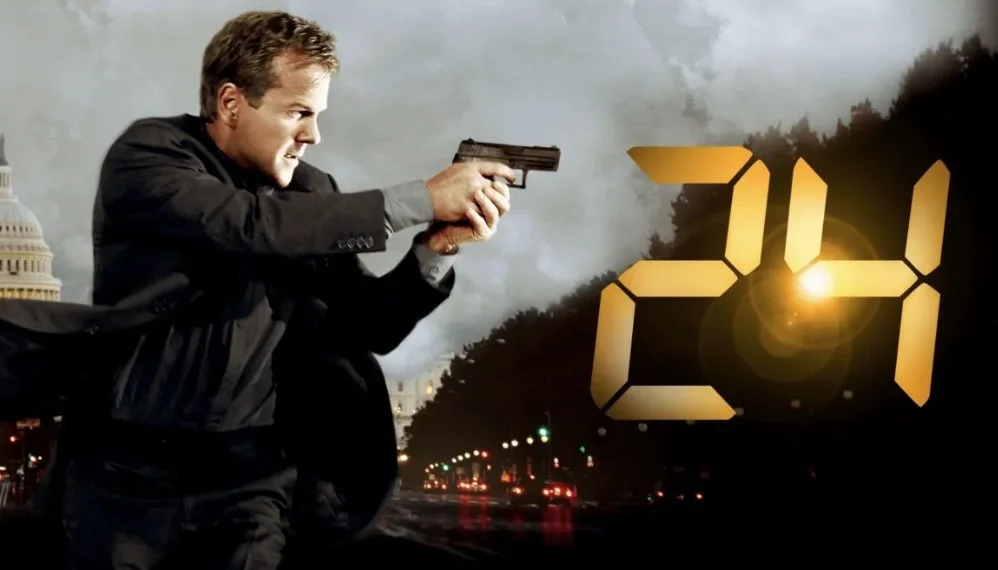
Countdown: Kiefer Sutherland in deadline time-based thriller series 24
ONE HOUR LEFT:
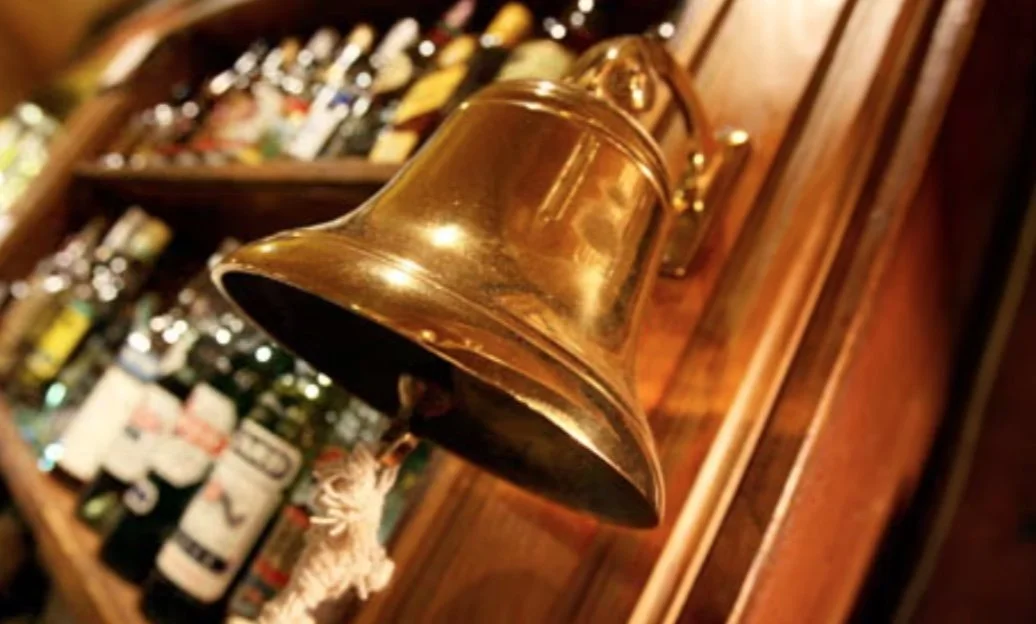
So a thronging bar today, I'm ringing a first warning bell to crowd of famous visitors that the deadline is approaching not merely for final drinks, but also perspectives on this subject. Unsurprisingly, as usual, it is full of creative people with something to say, broadly in three parties - those who like a deadline, those who don't, and those who sit somewhere in the middle.
Jack White of White Stripes fame reckons deadlines are vital: "Deadlines make you creative. Opportunity and telling yourself you have all the time in the world, all the money in the world, all the colors in the palette, anything you want-that just kills creativity."
Ben Folds is here, and agrees that he needs the pressure and the discipline: "I start songs all the time. If I weren't so lazy, I would finish them. It's like when I have a deadline I have to. I always feel very lucky that I am forced to make records at certain times. If I was forced to make 2 records a year, I would write twice as many songs. I can't make myself finish something unless I am forced."
Animation is a discipline requiring extremely long hours. Creatives in this genre simply cannot put off getting on with it. ”If we didn't have deadlines, we'd stagnate," draws Walt Disney - with a clear conclusion.
Another American cartoonist, Jeff MacNelly, agrees. "The best thing for my creative process is a deadline."
And here's Simpsons creator Matt Groening: "I've been deadline-driven for my whole grown-up life, and that hasn't gone away. It is nice to be able to reflect about the big picture, about what kind of stories you want to tell, and how to take advantage of success."
Fans of deadlines come in all guises. Even the wild man of drink and drugs, but also writing, Hunter S. Thompson, was as dependant on them as various substances: "I couldn't imagine, and I don't say this with any pride, but I really couldn't imagine writing without a desperate deadline."
The novelist and screenwriter William Monahan (author of The Departed) even tells us that: "I never work until I have a deadline. You have to fit so much in a given day that you just don't get serious until you know when the deadline is."
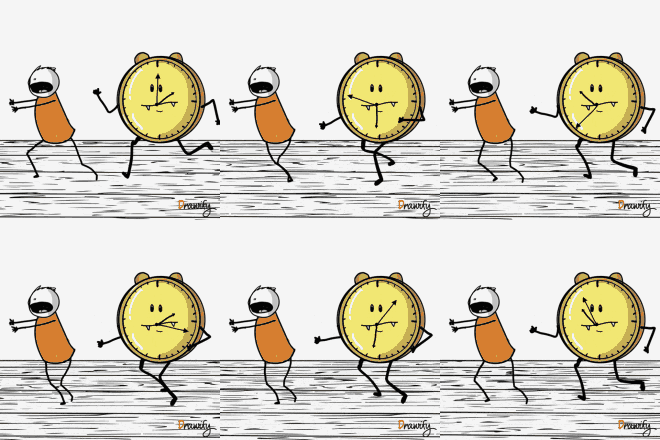
20 MINUTES, LADIES AND GENTS:
And in a very different realm, the knitting writer Stephanie Pearl-McPhee, known for her popular knitting projects, is likely to drop stitches without one, but adds this humorous nuance:“I am a person who works well under pressure. In fact, I work so well under pressure that at times, I will procrastinate in order to create this pressure.”
But some in the Bar aren't so keen. “Deadlines produce haste and the feeling of a great weight pressing down on my neck, and both of these get in the way of writing," says Anton Chekhov.
"Well, I've never met a deadline I couldn't miss. I make sure my editors know this," declares a bullish Carrie Fisher.
“There are no unrealistic goals, only unrealistic deadlines," declares the Canadian-American motivational public speaker and author Brian Tracy, with a generalised grandiosity,.
The film director Asif Kapadia reckons that deadlines are obstacles to achievement and reckons projects should just take as long as is required: “My film Senna took five years, Amy [about Amy Winehouse] took three years. You try and say, 'Look, there's no deadline.' That's important. Just saying, 'We've got to make the film. And once the film's ready, it will be out there."
Author Dave Barry is very suspicious of publishers’ deadlines. "I think I've learned over the years, because you'd have to be stupid not to, that when a book publisher gives you a deadline they're just kidding for the most part. I don't know what they do with it, it's like you send them your book and they just hold it in their hands for like six months and I don't know why, and you realise you probably had more time."
That’s very true indeed. ”Yes," says David Benioff, author and co-creator of Game of Thrones. "With the movies, people are not going to wait around. The deadline is a deadline. In publishing it's more a polite suggestion."
Some focus deadlines but still miss them. "I work best after the deadline has passed, when I'm in a panic," admits Tony Kushner.
Karl Kraus, the Austrian writer, journalist, satirist, essayist, aphorist, playwright and poet takes a humorous, if accurate angle: "Journalist: a person without any ideas but with an ability to express them; a writer whose skill is improved by a deadline: the more time he has, the worse he writes."
5 MINUTES. HURRY UP NOW …
Right … so … here's another author, Tom Robbins, from his book Half Asleep in Frog Pajamas, posing a question: “Are you aware that rushing toward a goal is a sublimated death wish? It's no coincidence we call them 'deadlines.”
So death of course is the ultimate deadline. So let's end on a serious note from the American actor Dean Stockwell: “There are a lot of problems in the world, a lot of tragic things that have to be addressed, economic, medical, political, all kinds of things, but, to my way of thinking, they pale in comparison to the overall problem of the environmental deadline.”
Meanwhile though, I'm up to, and going over this weekly Thursday one, so the bell tolls for me, and it's time to bring in this week's whip-cracking time-keeper to get your motivated for the next deadline at 11pm on Monday UK time, returning the chair - Maki! Time is ticking. Place your nominations below, before that final bell goes.
New to comment? It is quick and easy. You just need to login to Disqus once. All is explained in About/FAQs ...
Fancy a turn behind the pumps at The Song Bar? Care to choose a playlist from songs nominated and write something about it? Then feel free to contact The Song Bar here, or try the usual email address. Also please follow us social media: Song Bar X, Song Bar Facebook. Song Bar YouTube, and Song Bar Instagram. Please subscribe, follow and share.
Song Bar is non-profit and is simply about sharing great music. We don’t do clickbait or advertisements. Please make any donation to help keep the Bar running.