
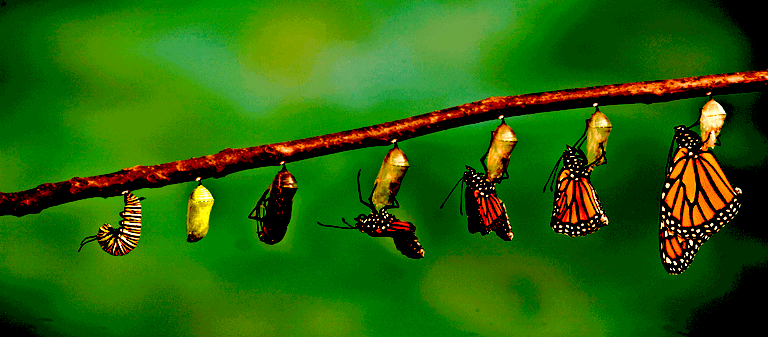
By The Landlord
“As Gregor Samsa awoke one morning from uneasy dreams he found himself transformed in his bed into a gigantic insect. He was lying on his hard, as it were armour-plated, back and when he lifted his head a little he could see his dome-like brown belly divided into stiff arched segments on top of which the bed quilt could hardly keep in position and was about to slide off completely. His numerous legs, which were pitifully thin compared to the rest of his bulk, waved helplessly before his eyes. … What has happened to me? he thought. It was no dream.” – Franz Kafka, The Metamorphosis
“Awakening is not a thing. It is not a goal, not a concept. It is not something to be attained. It is a metamorphosis. If the caterpillar thinks about the butterfly it is to become, saying ‘And then I shall have wings and antennae,’ there will never be a butterfly. The caterpillar must accept its own disappearance in its transformation. When the marvelous butterfly takes wing, nothing of the caterpillar remains.” – Alejandro Jodorowsky
“Life and death are illusions. We are in a constant state of transformation.” –Alejandro Gonzalez Inarritu
“The world of art is not a world of immortality but of metamorphosis." – Andre Malraux
“What you see is my old shell; inside it’s all changed.” – R.K. Narayan, A Tiger for Malgudi
“You must be the change you wish to see in the world.” – Mahatma Gandhi
Good morning, afternoon or evening, wherever you are in the world, as we open the global Song Bar doors after a hopefully restorative holiday, bringing a smile, brewing a coffee, stirring up some special hair of the dog, or whatever is your soothing fix, as we get back in the swing and the musical mix – for 2026.
Many of us make resolutions for this time of year, with pledges over habits, health and more, but rarely do they stick. But we begin the year not with any old life alteration theme, but change that is profound, and utterly transformative.
Has this ever happened in your life, physically or mentally, or have you witnessed it in others? It might come about by a sustained commitment to lifestyle, diet or exercise, or be triggered by experiences good or bad – love and relationships, major career changes, a chance encounter, fortune or tragedy, a sudden huge idea or even spiritual revelation. It might be sudden, or gradual processes in nature, though perhaps not as profound as that of tadpole to frog, or the miracle of caterpillar to monarch butterfly. All of this happens in real life, and of course can be related, literally or metaphorically, for the sometimes transformative experience of song.
Ideas of transformative change come in many forms across history and culture inspiring a range of stories, images and emotions. "In the Middle Ages and the Renaissance, man's dispute with madness was dramatic debate in which he confronted the secret powers of the world; the experience of madness was clouded by images of the Fall and the Will of God, of the Beast and the Metamorphosis, and of all the marvellous secrets of Knowledge,” writes Michel Foucault.
But what most comes to mind is Franz Kafka’s shocking, striking 1915 novella The Metamorphosis, which instantly grabs us with a potent mix of the literal and metaphorical, an expression of deep psychological as well as physical change in the rapid change of the 20th century, Gregor’s trauma, provoked by work stress, his daily life also transformed by the response of those around him, especially his sister and father, feelings of nausea and disgust as well a shame and confusion, prompting all sorts of psychoanalytical interpretations.
And yet despite his new beetle-like new body, the irony is that he still feels human: "I cannot make you understand. I cannot make anyone understand what is happening inside me. I cannot even explain it to myself,” he explains in this first-person narrative. And perhaps most profound, and relevant to this song topic, this declaration: “Was he an animal, that music could move him so?”
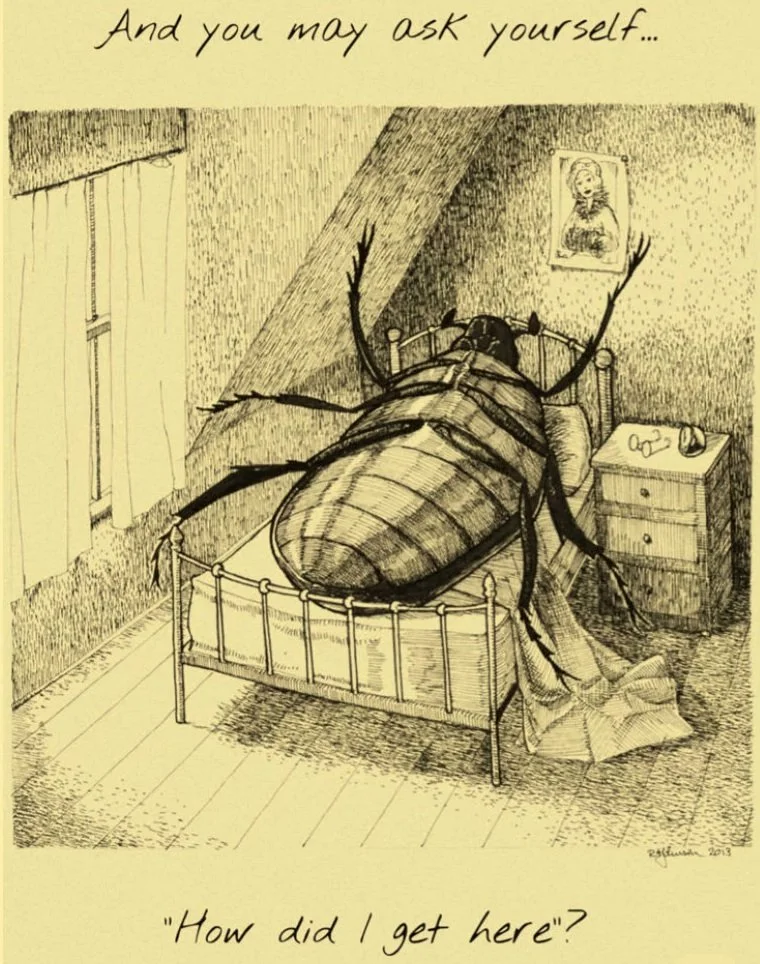
A reading of Kafka’s The Metamorphosis
Those radical mental change states are part of the zeitgeist, with Carl Jung chiming in on his 1912 Symbols of Transformation, exploring impulses that arise from the unconscious, and here, on reaching the age of 36: “The time is a critical one, for it marks the beginning of the second half of life, when a metanoia, a mental transformation, not infrequently occurs.”
And in a parallel revolution of existential thought, here’s Jean-Paul Sartre, capturing the gradual and the sudden forms of transformation: “I must finally realise that I am subject to these sudden transformations. The thing is that I rarely think; a crowd of small metamorphoses accumulate in me without my noticing it, and then, one fine day, a veritable revolution takes place.”
Your musical inspiration may come also from other cultures, such as in Indian or India-inspired music, and the Hindu system of four life stages known as ashramas, the fourth being that of the sanyasa, or sanyasi, a renunciation of material desires and prejudices, with the purpose of spending one's life in peaceful, spiritual pursuits. This has been reflected in many stories translated into western culture, but is also, reflected, for example in R.K. Narayan's 1983 novel A Tiger for Malgudi, in which a titular big cat undergoes a profound change from normal wild jungle life, being captured by poachers and sold to a circus, then killing his cruel trainer, but eventually becalmed and transformed by the sanyasi master or monk who befriends him. The tiger’s intimidating physical presence remains the same but he is transformed within.
Many music artists have radically changed their look, or musical style, successfully or otherwise, over long careers. Most notably of course is the great “Chameleon, Comedian, Corinthian and Caricature” David Bowie, but in different ways, various members of the Beatles, Bob Dylan, or the likes of Miles Davis, Michael Jackson, Joni Mitchell, Kate Bush, Bjork or even Beyoncé have undergone some bold creative changes across their careers.
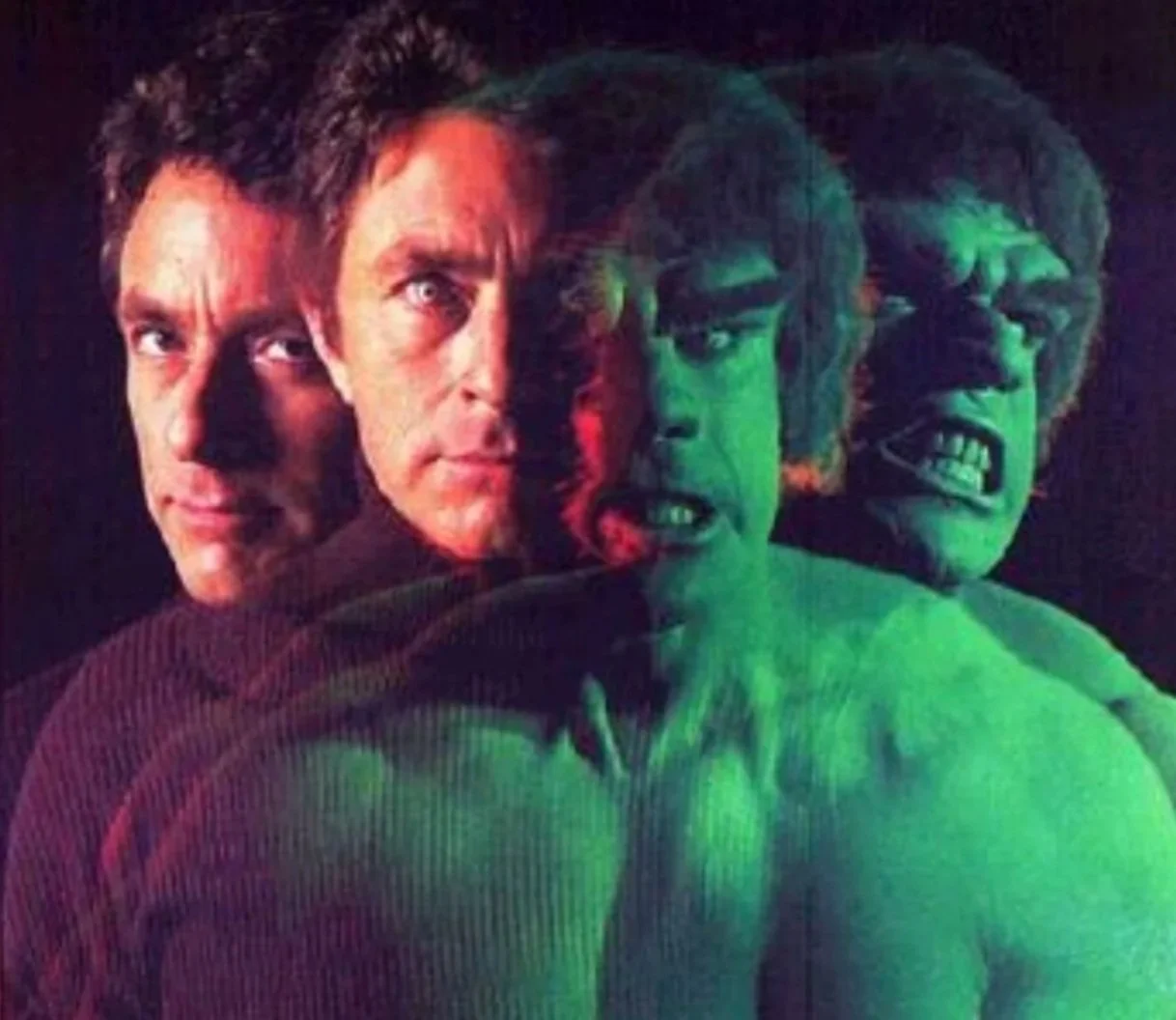
Bruce Banner. Anger issues …
Physical transformations are also the stuff of entertainment, whether that be Jekyll and Hyde, or the cartoon character turned screen legend The Incredible Hulk. I loved watching the original 1970s TV series with the calm Bruce Banner provoked by pain or anger (perhaps, like Kafka’s Gregor Samsa), except into the form of Lou Ferrigno’s massive green muscle man with a terrible haircut. My mum, who also was a bit of a fan, always used to mischievously remark how incredible also it was that Banner would burst out everything, and yet his trousers would remain intact above the knee.
I don’t know about how you feel at certain times, but you wouldn’t like me when I’m … hungry.
On that note, but also in musical terms, and a huge influence on Michael Jackson too, was this wondrous scene from John Landis’s brilliant 1981 comedy/horror An American Werewolf in London, preceded by feeling restless and irrationally hungry, and a fabulously clever buildup, intertwining camerawork and full-moon song.
On the film front, and joining us in the Bar are further random but relevant guests enjoying a drink, including the brilliant Andy Serkis, best known for transforming his voice, and body movements into Lord of the Rings seething big-eyed creature Gollum. “The art of transformation is a very important thing to me, and I always believe I can say something more truthful through characters that are further away from me,” he declares.
And from another type of transformation, the king and queen of drag, here’s RuPaul, who sums up the artform thus: “When you become the image of your own imagination, it's the most powerful thing you could ever do.”
Another performer joining our theme is Nia Peeples from the 80s TV series Fame: "Life is a moving, breathing thing. We have to be willing to constantly evolve. Perfection is constant transformation."
Finally from earlier in the 20th century, two writers and who lived creativity and pleasure to the full: “I take pleasure in my transformations. I look quiet and consistent, but few know how many women there are in me,” declares Anaïs Nin.
And here’s her lover Henry Miller, capturing the momentum of change with all of its contrasting opposites: "The art of living is based on rhythm - on give & take, ebb & flow, light & dark, life & death. By acceptance of all aspects of life, good & bad, right & wrong, yours & mine, the static, defensive life, which is what most people are cursed with, is converted into a dance, 'the dance of life,' metamorphosis.”
So then, it’s time to transform the beginning of your 2026 with songs on this theme. Ringing in the metamorphosis-level change is the powerful perceptions of thre all-knowing Uncleben! Please your life-changing nominations in comments below, for deadline at 11pm UK time on Monday, for playlists next week. For all sorts of reasons, here’s to a year of radical change …
New to comment? It is quick and easy. You just need to login to Disqus once. All is explained in About/FAQs ...
Fancy a turn behind the pumps at The Song Bar? Care to choose a playlist from songs nominated and write something about it? Then feel free to contact The Song Bar here, or try the usual email address. Also please follow us social media: Song Bar X, Song Bar Facebook. Song Bar YouTube, and Song Bar Instagram. Please subscribe, follow and share.
Song Bar is non-profit and is simply about sharing great music. We don’t do clickbait or advertisements. Please make any donation to help keep the Bar running.