
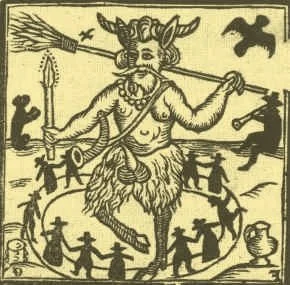
By The Landlord
“The Trickster violates principles of social and natural order, playfully disrupting normal life and then re-establishing it on a new basis … The Trickster isn’t a run-of-the mill liar and thief. When he lies and steals, it isn’t so much to get away with something or get rich as to disturb the established categories of truth and property and, by so doing, open the road to possible new worlds.” – Lewis Hyde, Trickster Makes This World: Mischief, Myth, and Art
“The trickster likes few things better than tweaking the nose of the doubters. They exist in the liminal space beyond proof, crossing boundaries at a whim, promising hidden knowledge they will never share.” – Thomm Quackenbush, The Curious Case of the Talking Mongoose
“Many native traditions held clowns and tricksters as essential to any contact with the sacred. People could not pray until they had laughed, because laughter opens and frees from rigid preconception. Humans had to have tricksters within the most sacred ceremonies for fear that they forget the sacred comes through upset, reversal, surprise. The trickster in most native traditions is essential to creation, to birth.” – Byrd Gibbens
“Primitive societies, or social groupings, had shamans, and some of them even more recent in time. Shamans were tricksters. There was a tradition of the trickster, and the trickster was a clown, a humorous fellow. His task was to trick the gods, to humour the gods into laughing, so that there was access to the divine - because laughter is a moment when we are completely ourselves." – George Carlin
“Obviously the raven with the unquenchable itch was at it again, playing tricks on the world and its creatures. Once by air, he thought, and now by water.” – Mordecai Richler, Solomon Gursky Was Here
“Listen, Peaches, trickery is what humans are all about," said the voice of Maurice. "They're so keen on tricking one another all the time that they elect governments to do it for them.” – Terry Pratchett, The Amazing Maurice and His Educated Rodents
“The trickster's function is to break taboos, create mischief, stir things up. In the end, the trickster gives people what they really want, some sort of freedom.” - Tom Robbins
“The trickster, the riddler, the keeper of balance, he of the many faces who finds life in death and who fears no evil; he who walks through doors.” – Christopher Paolini
“It’s in the very trickery that it pleases me. But show me how the trick is done, and I have lost my interest therein.” - Seneca the Younger
“Appear weak when you are strong, and strong when you are weak.” – Sun Tzu
“The greatest deception men suffer is from their own opinions.” – Leonardo da Vinci
“Yet is beauty the pleasing trickery that cheateth half the world.” – Martin Farquhar Tupper
“History shows that ... (people) can be deflected from their natural tendencies by artful propaganda, bogus crises, or other political trickery.” – Robert Higgs
“Lobbying – the world's second oldest profession.” – Bill Press
“Lord, what fools these mortals be!” – William Shakespeare, A Midsummer Night’s Dream
Crafty, underhand and mischievous, using slippery ways to deceive, cheat or steal? Shapeshifters and liars deliberately misleading others by words, action or appearance? Sounds familiar?
It comes in all shapes and forms. Trickery, tricksters and dark arts of fakery are as at large today as they've ever been across all sides of life, from the more local food-stealing street foxes to pesky phone-stealing teenagers, false bottoms (of the bizarre silicone kind), post-truth culture, AI-generated images, to massive, tax-avoiding political liars. As old as the human race, and long before us, trickery is part of the fabric of life, a sliding scale of survival instinct, of finding a meal and sometimes a lot more than that, but a parallel art is in recognising it, and it's such a slippery subject that it's easy to get sidetracked and fooled and distracted into other areas, so where do we begin?
It would be tempting to go straight for current political contexts, with so much of that at the forefront of news and affairs, but colourful stories of trickery are deep within our history across many cultures and mythology in repeating patterns, from Greek gods to birds and animals, and a good starting point may be to go back to go forward, using older tales and figureheads, and so perhaps begin with folk or traditional music and stories, and then spread outwards.
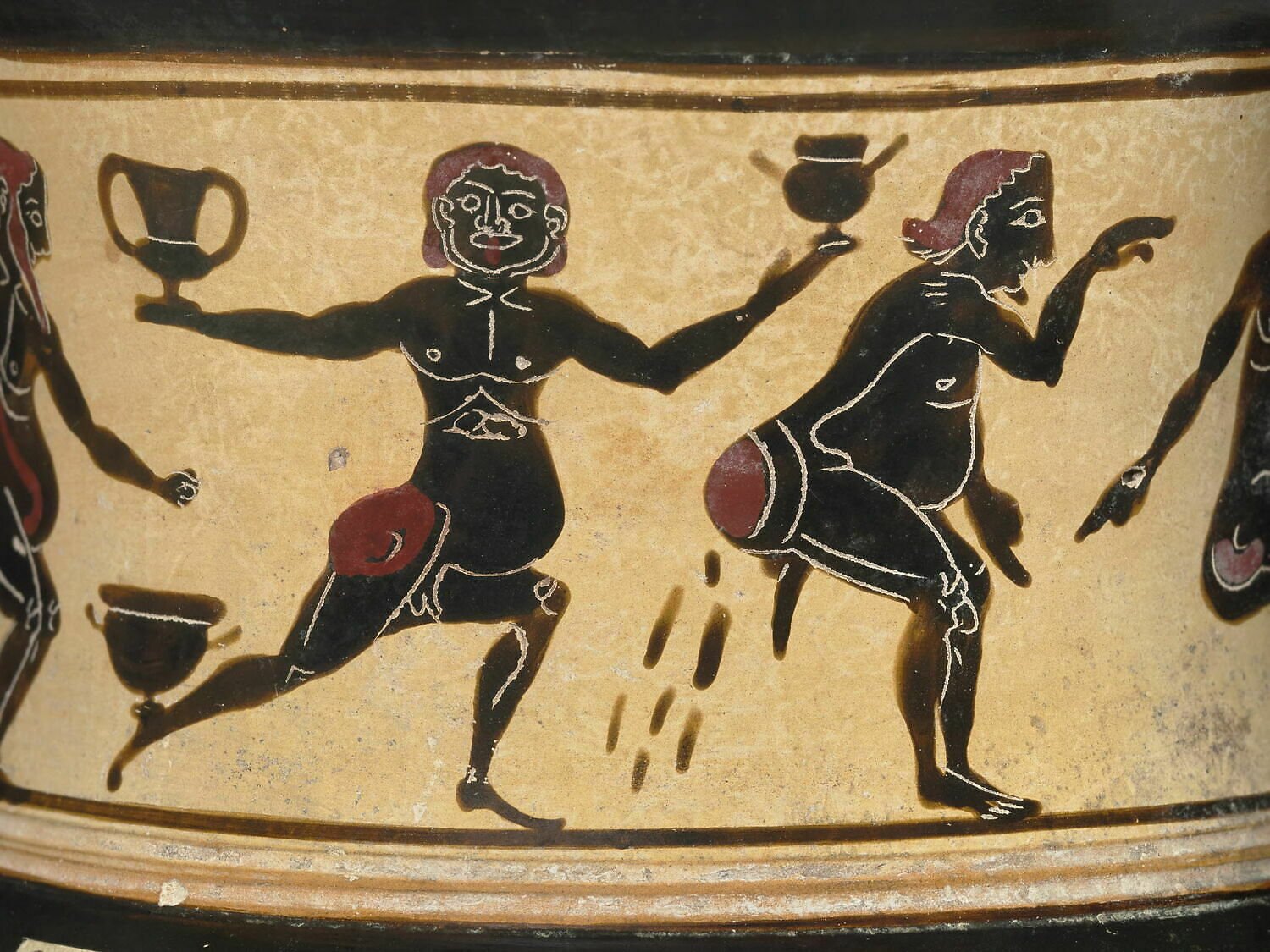
Ancient Greek vases contain many images of ritual mockery, part of trickster culture
The Greek god Hermes, for example is a classic trickster, a disruptor, the patron of thieves and the inventor of lying, and also as the story goes, as one-day-old baby, left the cave of his birth, turned a tortoise shell into a musical instrument and challenged the god Apollo, the established order, to a singing contest. This was just the very beginning of his many tricks.
Traditionally then, the trickster figure is an agent of chaos, a force of change, of creativity, a disruptor, an enemy of the status quo. He (usually male as is other portrayed) isn’t entirely evil, nor good, and has no real ideology other than needing a meal, and to restlessly mess with the norm.
The Trickster, the jester, the fox, the crow, the raven, and many others, is always at large, eager to get up to tricks, and needs to be fed, or chaos will be unleashed.
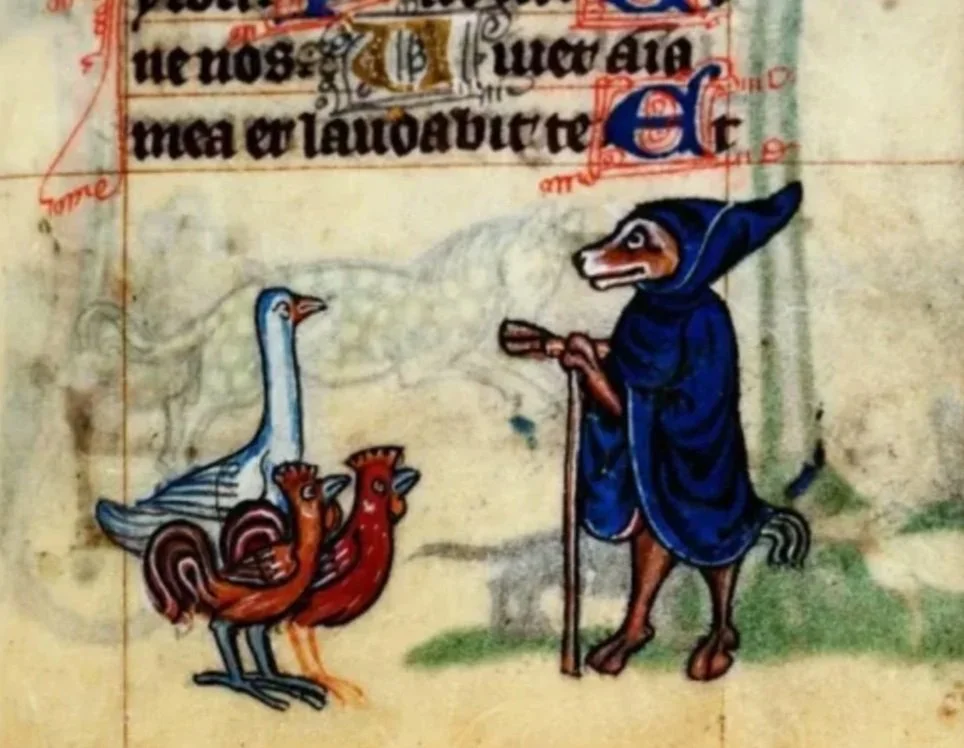
Reynard the fox
Mythological stories, whether they take various anthropological animal, god or human form, from fox or coyote to crow, raven, have common patterns - they often feature quite a bit of shit-spreading, literal or metaphorical, and some bawdy behaviour. One of the most colourful is that of the Coyote myth stories of many of Indigenous peoples of North America, particularly in the Winnebago tradition of the Great Lakes region, with Coyete’s "flying penis" or detachable penis, a sort of detachable drone going on long, sneaky missions in pursuit of penetration.
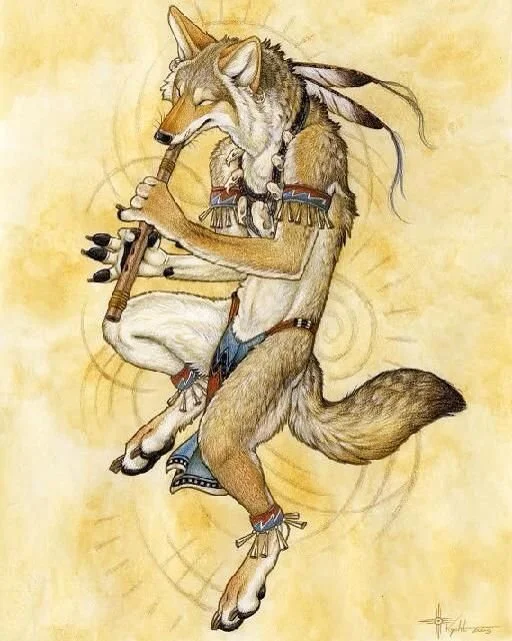
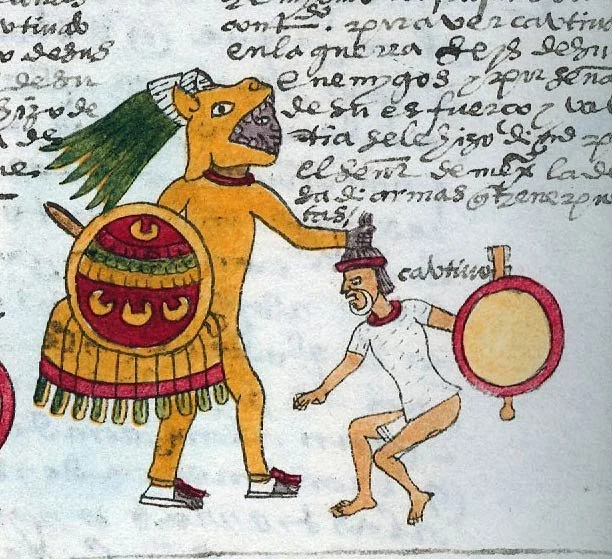
North American and Mexican depiction of the tricky Coyote
The Ho-Chunk, also known as Hocąk, Hoocągra, or Winnebago are a Siouan-speaking Native American people whose historic territory includes parts of Wisconsin, Minnesota, Iowa, and Illinois, now the Ho-Chunk Nation of Wisconsin and the Winnebago Tribe of Nebraska. The Trickster is a key figure in of all Native American culture. Also called the Wisakedjak (Wìsakedjàk in Algonquin, Wīsahkēcāhk in Cree and Wiisagejaak in Oji-Cree), features in countless stories. One that caught my eyes is his buffalo hunt which brings different trickery into play.
The Trickster sees a buffalo on a hill, and so schemes to create a group of scarecrows, which then deceives the buffalo into running onto muddy marshland on which the animal is trapped. The Trickster then kills the buffalo with his knife and starts to divide up the carcass. But then, while cutting up and beginning to eat, while there is plenty of food, the Trickster’s left and right suddenly begin fighting each other over who owns it, resulting in severe injury.
There are of course parallels modern with politics, the trickster tricking himself, as there are as many false tricksters at large as true one. One of the trickster’s tricks is to set people against each other, and to distract them from what they are really up to but this can also bite back.
Without going into it too deeply, but it has to be addressed, let’s not even pretend, for example, that Donald Trump’s Republican Party, or Nigel Farage’s UK Reform Party have anything at all do with people or policies. They do not stand for anything in a democratic or idealogical sense. They are divide-and-distraction trickster machines, simply corporate lobbying firms disguising themselves as political parties, a wolf in sheep’s clothing, simply selling their profile to rich funders, such as from the fossil fuel or cryto-currency sectors, or to anyone power-driven media organisation, industry or state, seeking to create legal or tax havens, all wrapped in a sheepskin blame-culture disguise of sellable British or American national identity. I think that about wraps that up.

Modern shapeshifting tricksters, thinly disguised as politicians, but in reality, just shit-slinging payees of tax-avoiding lobbyists …
But let’s get back to the colourful culture of trickster stories that have brought us centuries of song. Your songs might include the trickery of anyone from Azeban the racoon, the Aztec Huehuecoyotl, North America’s Brer Rabbit, Bantu’s Hare, Celtic culture’s fairies or puca, France’s Reynard the fox, Germany’s Pied Piper, Hopi culture’s Kokopelli, Japan’s Kitsune, Susanoo, Kappa, Bake-danuki and Hare of Inaba, the crazy Norse god Loki, to the Tibetan Akhu Tönpa. There are many more of course, ancient and modern from mermaids to sirens, Cheshire cats to gremlins, Jokers and grifters. If trickery is in play, then give it ago.
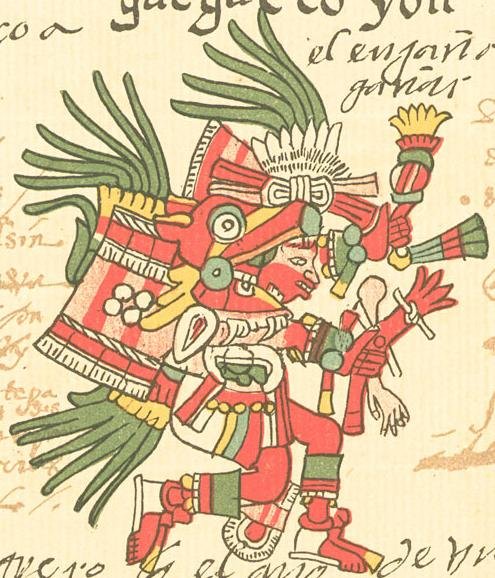
Aztec mythology’s Huēhuehcoyōtl
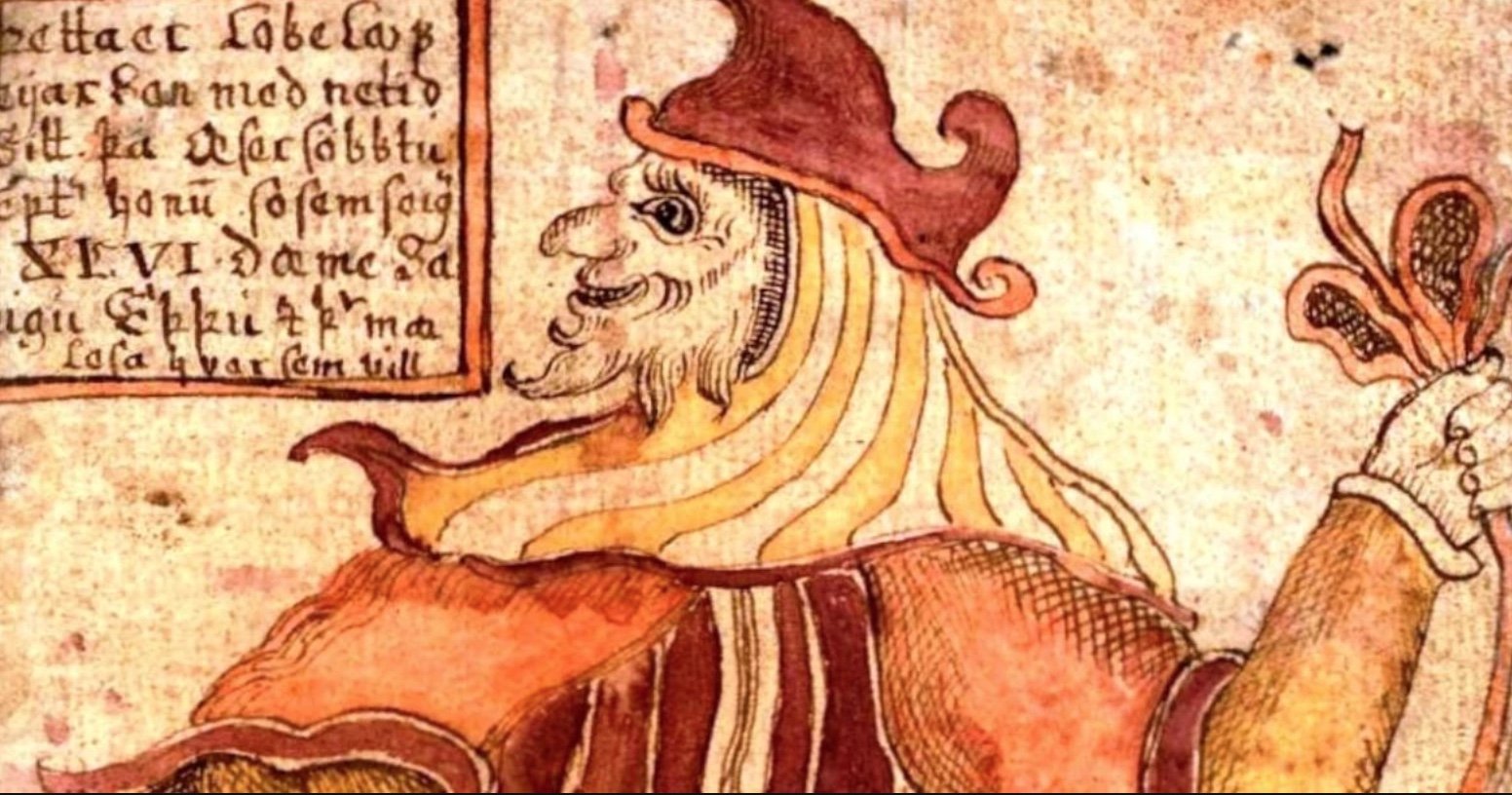
Loki the Norse god, who gets up to all sorts …
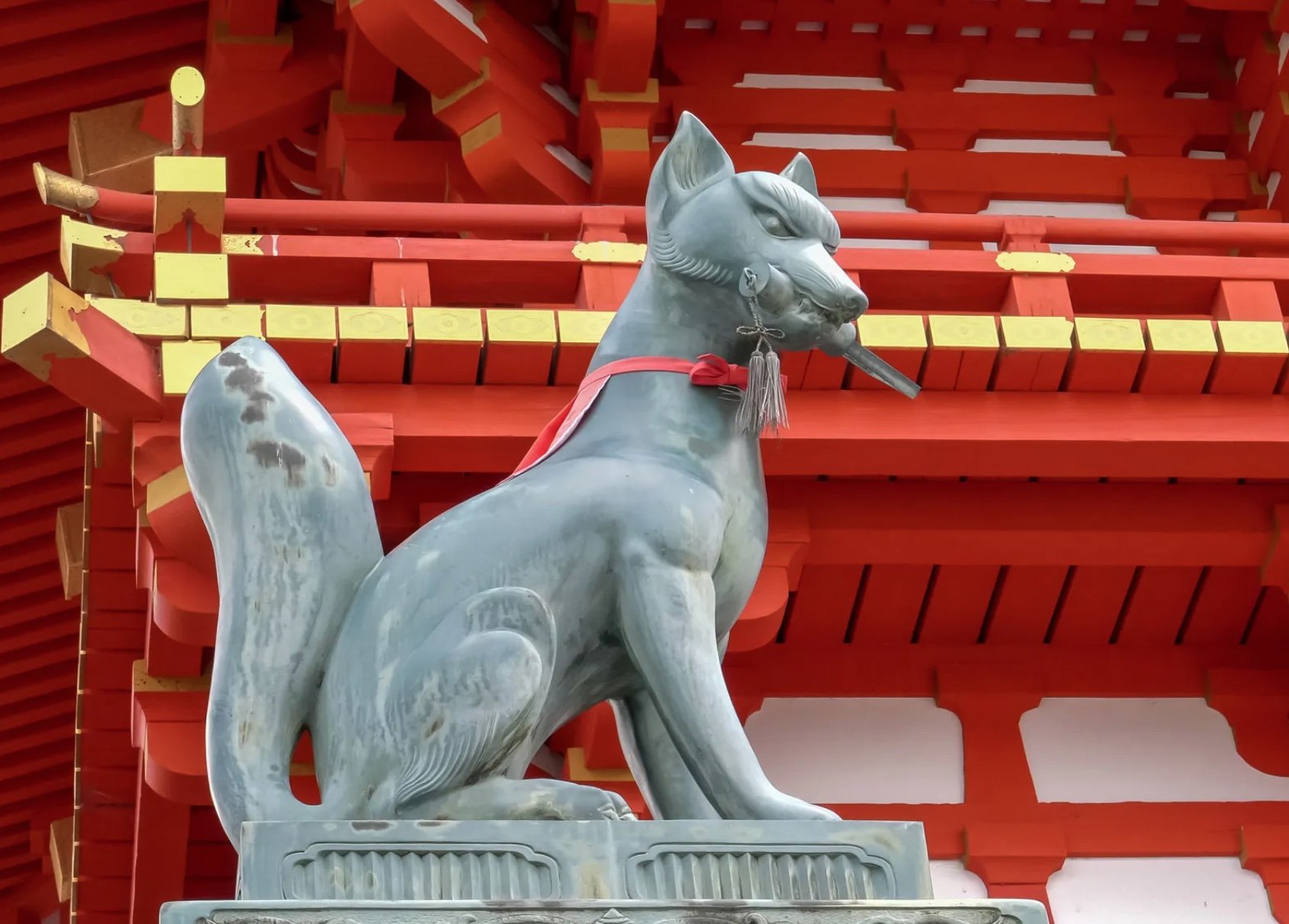
Foxy: statue of a Kitsune at Fushimi Inari shrine in Kyoto, Japan
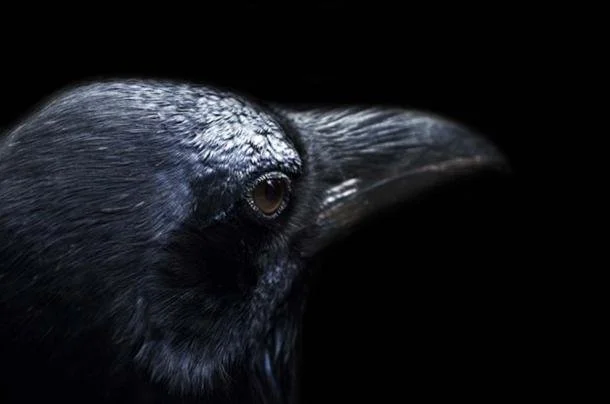
Crows and ravens. Keep an eye out …
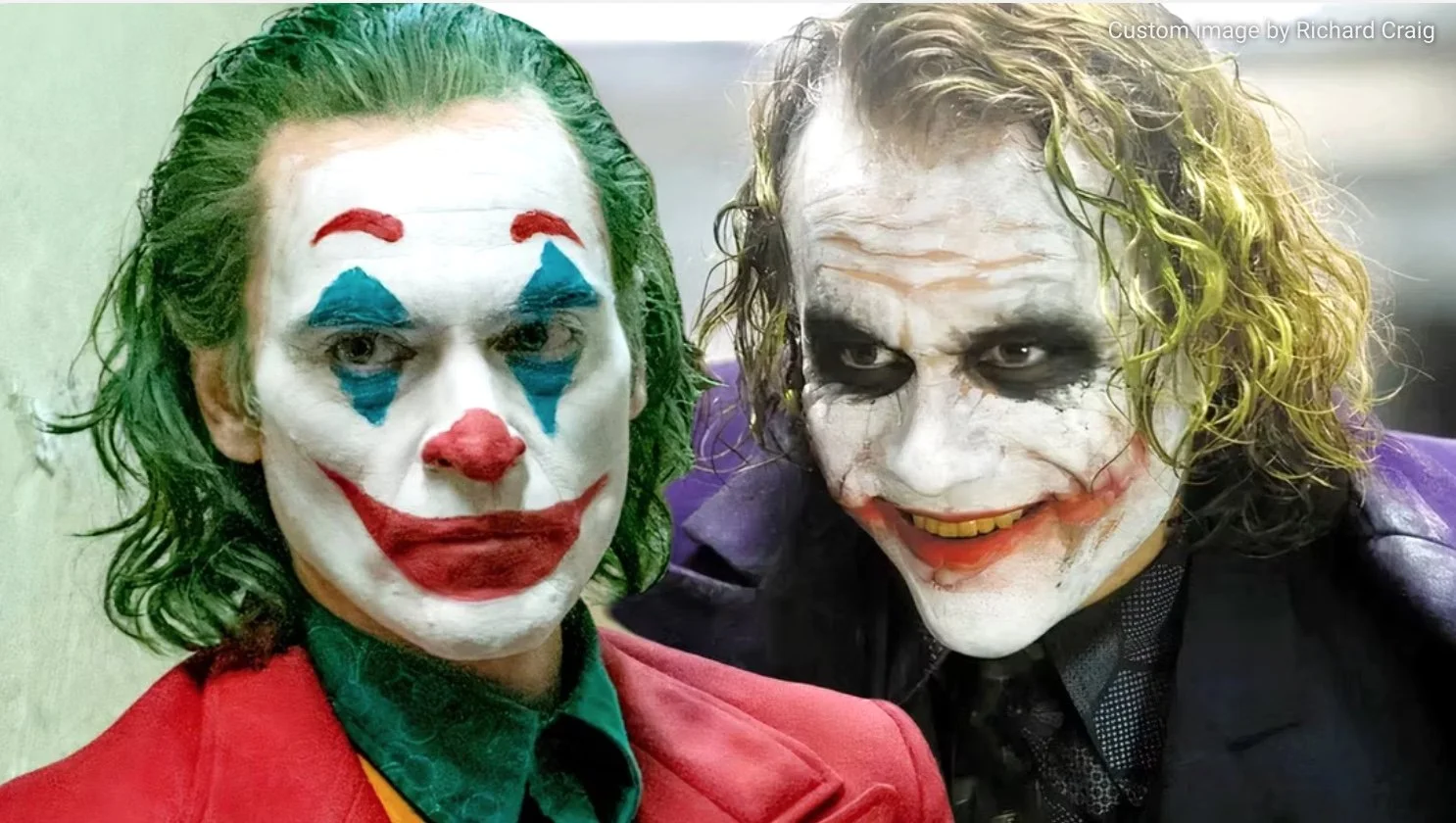
Agents of chaos: The Joker, played by Joaquin Phoenix and Heath Ledger
Sirens of song …
As a side argument, arguably are musicians and artists also a form of trickster, disruptors in art and music, those who fooled the status quo, and changed the way we think? And who might you think of, exemplied in their work in respect of this topic? Arguably a major driving force started in the late 1950s and then the 1960s by those who took LSD, such as Allen Ginsberg and his poem Howl, or Ken Kesey, who wrote the first few chapters of One Flew Over The Cuckoo’s Nest during a trip. Do any songs reflect trickery as disruptive change?
The tricky part is, however, that many who do disrupt, or create creative ripple in culture, even whole movement, then become so successful that their art is monetised and simply becomes a brand, a 10-step coaching course to enlightenment, a visionary ayahuasca trip becomes venture capitalism and a corporation.
It’s a potentially vast subject, but using timeless stories is a good way to start. For final inspiratioon, here are some examples in the poetry and film formats all expressing trickery.
Here’s a key speech from William Shakespeare, A Midsummer Night’s Dream, in which the mischievous Puck contrives to create chaos in the desires of those in the play within the play, with insight on how humans as much seek to trick themselves:
“Lovers and madmen have such seething brains,
Such shaping fantasies, that apprehend
More than cool reason ever comprehends.
The lunatic, the lover and the poet
Are of imagination all compact:
One sees more devils than vast hell can hold,
That is, the madman: the lover, all as frantic,
Sees Helen's beauty in a brow of Egypt:
The poet's eye, in fine frenzy rolling,
Doth glance from heaven to earth, from earth to heaven;
And as imagination bodies forth
The forms of things unknown, the poet's pen
Turns them to shapes and gives to airy nothing
A local habitation and a name.”
And finally, in a parallel topic, more about illusion (see past playlists, which also include songs about illusions, deception and authenticity), here are some entertaining music videos with visual trickery, from Squeeze’s play on the work of Rene Magritte and Salvador Dali (directed by Ade Edmondson), OK Go’s clever one-take studio of changing dimensions partly inspired by Swiss artist Felice Varini, Michel Gondry messing around with The White Stripes, and Bonobo with clever reduction of scale through the idea of a Japanese hikikomori by director Oscar Hudson.
So then, it’s time end this trickery and usher in your own. Making sense of these many tantalising tales and dancing around the deception, we welcome back to the Song Bar guru’s chair, the sharp ears and eyes of Suzi! Place your suggestions in comments below for deadline at 11pm on Monday UK time, for playlists published next week.
New to comment? It is quick and easy. You just need to login to Disqus once. All is explained in About/FAQs ...
Fancy a turn behind the pumps at The Song Bar? Care to choose a playlist from songs nominated and write something about it? Then feel free to contact The Song Bar here, or try the usual email address. Also please follow us social media: Song Bar X, Song Bar Facebook. Song Bar YouTube, and Song Bar Instagram. Please subscribe, follow and share.
Song Bar is non-profit and is simply about sharing great music. We don’t do clickbait or advertisements. Please make any donation to help keep the Bar running.