
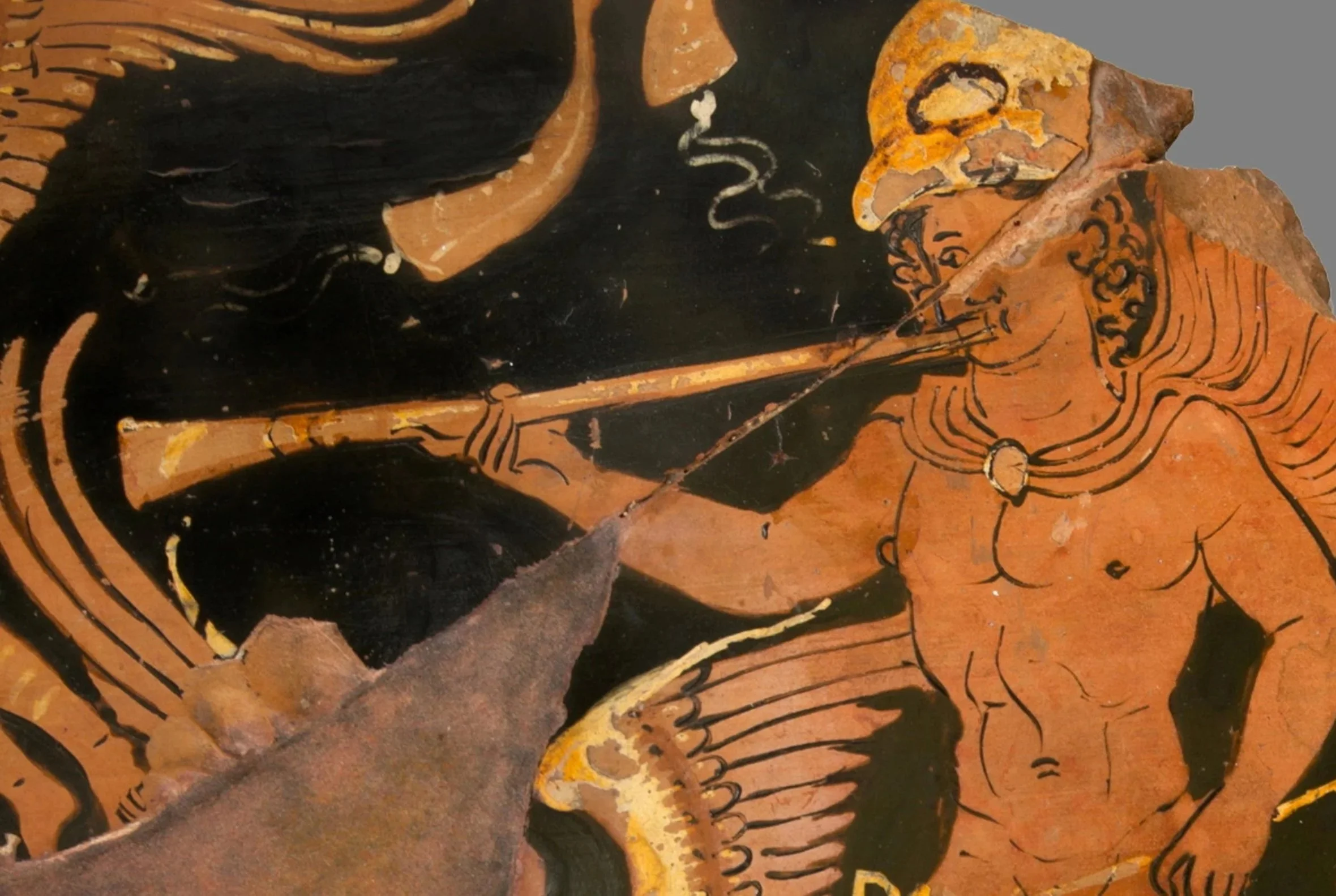
This very imposing, loud, resonant noun is an ancient Greek, trumpet-like instrument used as a tactical signal on the battle field, as well as to signal the beginnings of gatherings, or of races in sport.
An instrument that made its presence felt, its was made from a narrow bronze tube with a mouthpiece of bone and a bell (also constructed of bronze) of variable shape and size, often with conical, bulb-like, and spherical structures. Some used a phorbeia, a leather strap typically worn on the face of aulos players to support their embouchure and allow for the projection of a strong sound.
Records include notable players (known as salpinktes) with extraordinary levels of stamina. They include Herodorus of Megara, a late-4th century BCE salpinktes, described has possessing enormously strong lungs and a very healthy appetite and who stood over 7ft tall. He is said to have slept on bear skin and could play two salpinges at once. He was able to produce sound so loud it would dissuade anyone within his vicinity, and apparently aided in Demetrius I Poliorcetes’s conquest of Argos. Another is Epistades, a salpinktes also from the 4th century BCE, and described by Pollux as being audible from around 8.9km away.
Archias of Yvla was another salpinx player from the classical period, who was celebrated for his astonishing ability to project his sound without any sort of amplifier, alongside winning three Olympic trumpet competitions and the Pythian games.
But not players were men. Aglaisi Megakleous was a 3rd-century BCE player who wore a helmet while playing at the first great procession in the city of Alexandria.
Here the sound is vividly recreated by by Petros Tabouris Ensemble via the Hellenicrecord label.
And this demonstration from the Musical Instrument Museum captures sounds thought to be heard during the original Olympic Games. Heralding competitive events including running, wrestling, chariot racing and tarting in 396 BCE (around 2,400 years ago), trumpeting contests were held to announce the festivities. Believed to be the only surviving ancient Greek trumpet, this salpinx made of 13 bone pieces and bronze joints:

An Alexandrian terracotta figures portay musicians playing the salpinx and the hydraulis (water organ) from the 1st century BCE

An early 5th-century BCE vase depicts a Greek soldier with spear and Salpinx
So then, any further salpinx-related examples to share from your own music library? Feel free also to share anything related whether in music or wider culture, such as from film, art, or other contexts, in comments below.
You can also get in touch the contact page, and also visit us on social media: Song Bar X, Song Bar Facebook. Song Bar YouTube. and Song Bar Instagram. Please subscribe, follow and share. New to comment? It is quick and easy. You just need to login to Disqus once. All is explained in About/FAQs ...
Song Bar is non-profit and is simply about sharing great music. We don’t do clickbait or advertisements. Please make any donation to help keep the Bar running: