By The Landlord
“Anyone who isn't confused really doesn't understand the situation.” – Edward R. Murrow
“No event in American history is more misunderstood than the Vietnam War. It was misreported then, and it is misremembered now.” – Richard M. Nixon
“How do you ask a man to be the last man to die in Vietnam? How do you ask a man to be the last man to die for a mistake?” – John Kerry, 1971
“Haunted and haunting, human and inhuman, war remains with us and within us, impossible to forget but difficult to remember.” – Viet Thanh Nguyen, Nothing Ever Dies: Vietnam and the Memory of War
“But if we withdraw, the Communists will take over. Would you like that?" American friends ask us. There are Vietnamese who are unable to answer this question. But not being able to answer it does not mean acceptance of a continuation of the present hopeless situation.” – Thich Nhat Hanh, Vietnam: Lotus in a Sea of Fire
“You can kill ten of my men for every one I kill of yours. But even at those odds, you will lose and I will win.” – Ho Chi Minh
“Why should they ask me to put on a uniform and go 10,000 miles from home and drop bombs and bullets on Brown people in Vietnam while so-called Negro people in Louisville are treated like dogs and denied simple human rights?” – Muhammad Ali
“We weren’t on the wrong side. We are the wrong side.” – Daniel Ellsberg, 1974
“What could it be in this country that transforms young, vibrant, innocent guys like me into steely-eyed, sharp-tongued, single -minded killers with “the thousand yard stare?” – Michael Zboray, Teenagers War: Vietnam 1969
“We are the unwilling, led by the unqualified, doing the unnecessary, for the ungrateful.” – Matthew Quick, The Reason You're Alive
In the title then, two slogans capturing how a country went through massive change. The war finally, formally ground to a halt just over 50 years ago, but all of major conflicts, its events, behavioural patterns, lessons, mistakes, rifts, disinformation and horrors echo on into the present and beyond scars from which America, in particular, but of course also the country itself, has never truly recovered, nor, as seems likely, has learned from. It's hard to think of a conflict that demonstrates more vividly the folly, hypocrisy and apocalyptic cost of superpowers sponsoring, supplying, meddling in and trying to profit from the affairs of smaller countries than that of Vietnam. And yet there are sharp parallels rippling still of that today.
It began after the country, after years of occupation by other powers including France and Japan, gained independence in the 1954 Geneva Conference when it was divided into two parts at the 17th parallel – leaving the Viet Minh, led by Ho Chi Minh, with support from the Soviet Union and China, controlling North Vietnam, while the US began to assume financial and military support for South Vietnam, held together by a Catholic Vietnamese leader Ngo Dinh Diem. All of this was during a sweaty climate of Cold War paranoia which slid out of control, fuelled by the fear of the “domino effect” of communist takeover, proclaimed by President Dwight D. Eisenhower on 7 April, 1954: “You have a row of dominoes set up; you knock over the first one, and what will happen to the last one is that it will go over very quickly.”
But what’s also extraordinary about the war (1955-1975) is that it coincided with, but also fuelled a cultural explosion – in books, film, art and especially new music, written, performed, recorded and distributed across evolving genres of pop, rock, folk and more, inspiring and changing more than one generation forever. So with this anniversary, and with poignant echoes into the present time, it seems like a prescient opportunity to aim to capture here at the Bar the music all about that conflict.
Hundreds of thousands killed and permanently maimed, multiple parties involved, the Vietnam War was hell for those there, but like a movie for for those who weren’t. Most Americans hadn’t even heard of the country, let alone where it was.
It’s a near impossibly complex subject, at first Vietnamese fighting each other, sponsored by others, and America getting involved, at first pretending just to train and supply South Vietnam, but sliding in with a series of errors and embarrassing defeats. When John F Kennedy came to power, he too made a series of fatal mistakes, embarrassed by the farcical failure of the Bay of Pigs Invasion in Cuba, and worried about the construction of the Berlin Wall. As Noam Chomsky writes in Power Systems: Conversations on Global Democratic Uprisings and the New Challenges to U.S. Empire:
“By the time John F. Kennedy became involved in 1961, the situation was out of control. So Kennedy simply invaded the country. In 1962, he sent the U.S. Air Force to start bombing South Vietnam, using planes with South Vietnamese markings. Kennedy authorized the use of napalm, chemical warfare, to destroy the ground cover and crops. He started the process of driving the rural population into what were called 'strategic hamlets,' essentially concentration camps, where people were surrounded by barbed wire, supposedly to protect them from the guerillas who the U.S. government knew perfectly well they supported. This 'pacification' ultimately drove millions of people out of the countryside while destroying large parts of it. Kennedy also began operations against North Vietnam on a small scale. That was 1962.”
On 2 January 1963, Battle of Ấp Bắc, lost by South Vietnam’s inept ARVN forces, defeated by the north’s VC (Viet Cong), was a major embarrassment for the US, with some of its helicopters shot down. By now it was impossible to pretend they were not directly involved in the war.
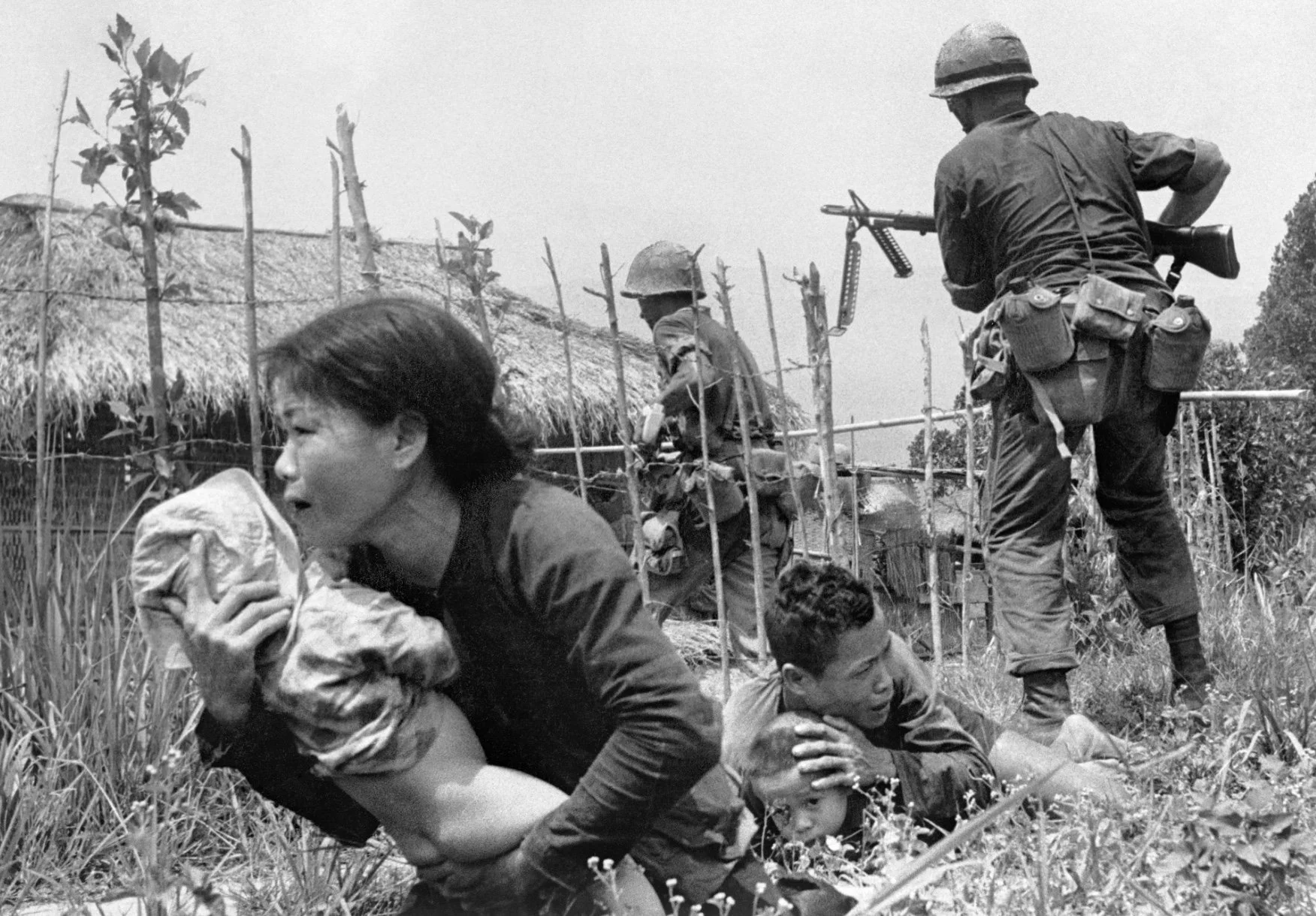
A Vietnamese woman carries a child to safety as US marines storm the village of My Son, near Da Nang, searching for Vietcong insurgents, 25 April 1965
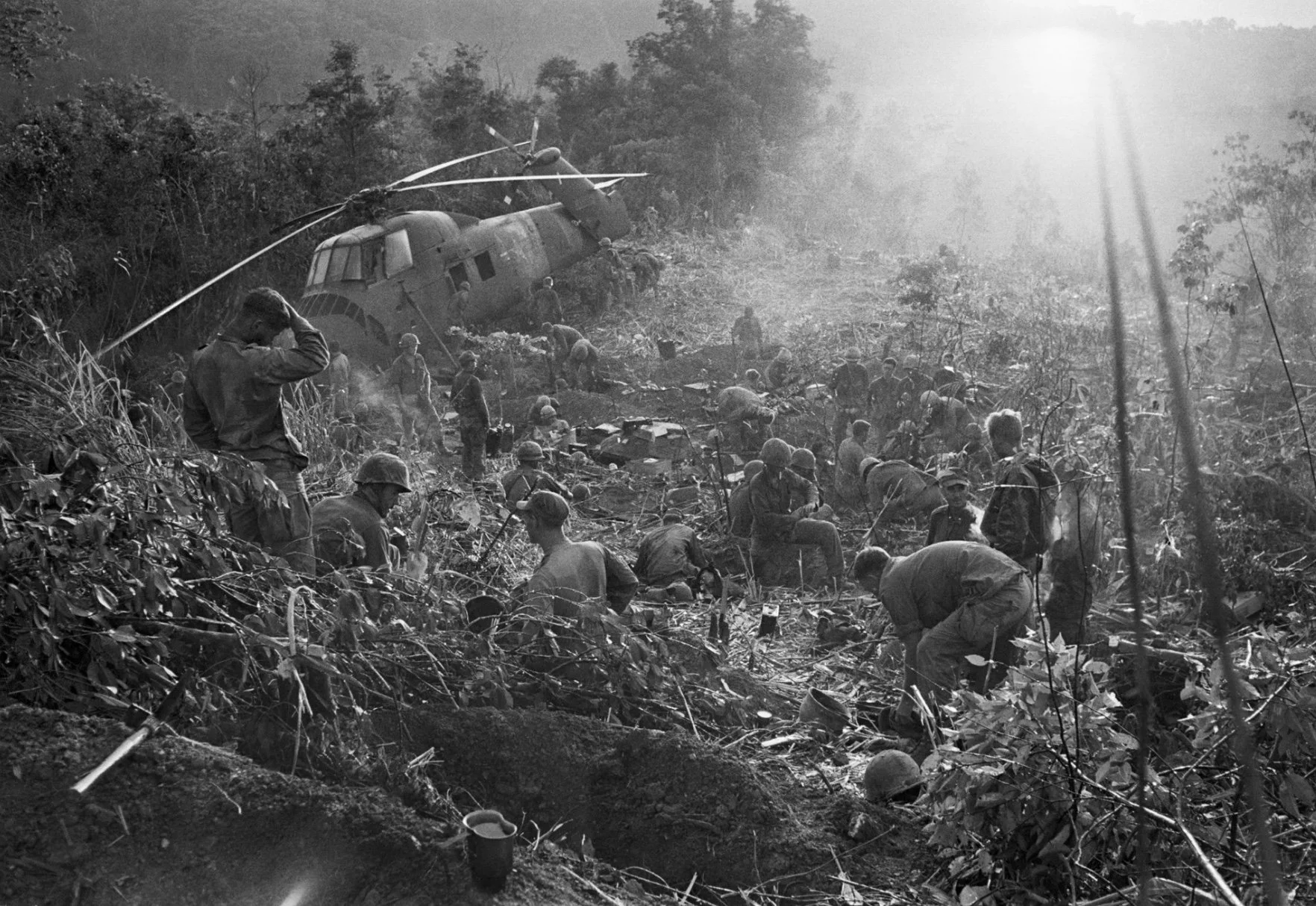
Marines emerge from their foxholes south of the DMZ after a third night of fighting against North Vietnamese troops in September 1966
Meanwhile South Vietnam had its own internal conflicts, the large Buddhist population unhappy at its Catholic president, and especially his brother who ran a brutal police force, unusually began a series of demonstrations which met with violent government reaction. Buddhist monks and women pull at a barbed-wire barricade that was set up in front of Saigon’s Giac Minh Pagoda to halt a demonstration on 17 July 1963. Police wielding clubs injured at least 50 people during the protest, one of many during this period by Buddhists opposed to the Diem regime. The following month, secret police raided temples throughout the country, an act that only heightened anger against the government.
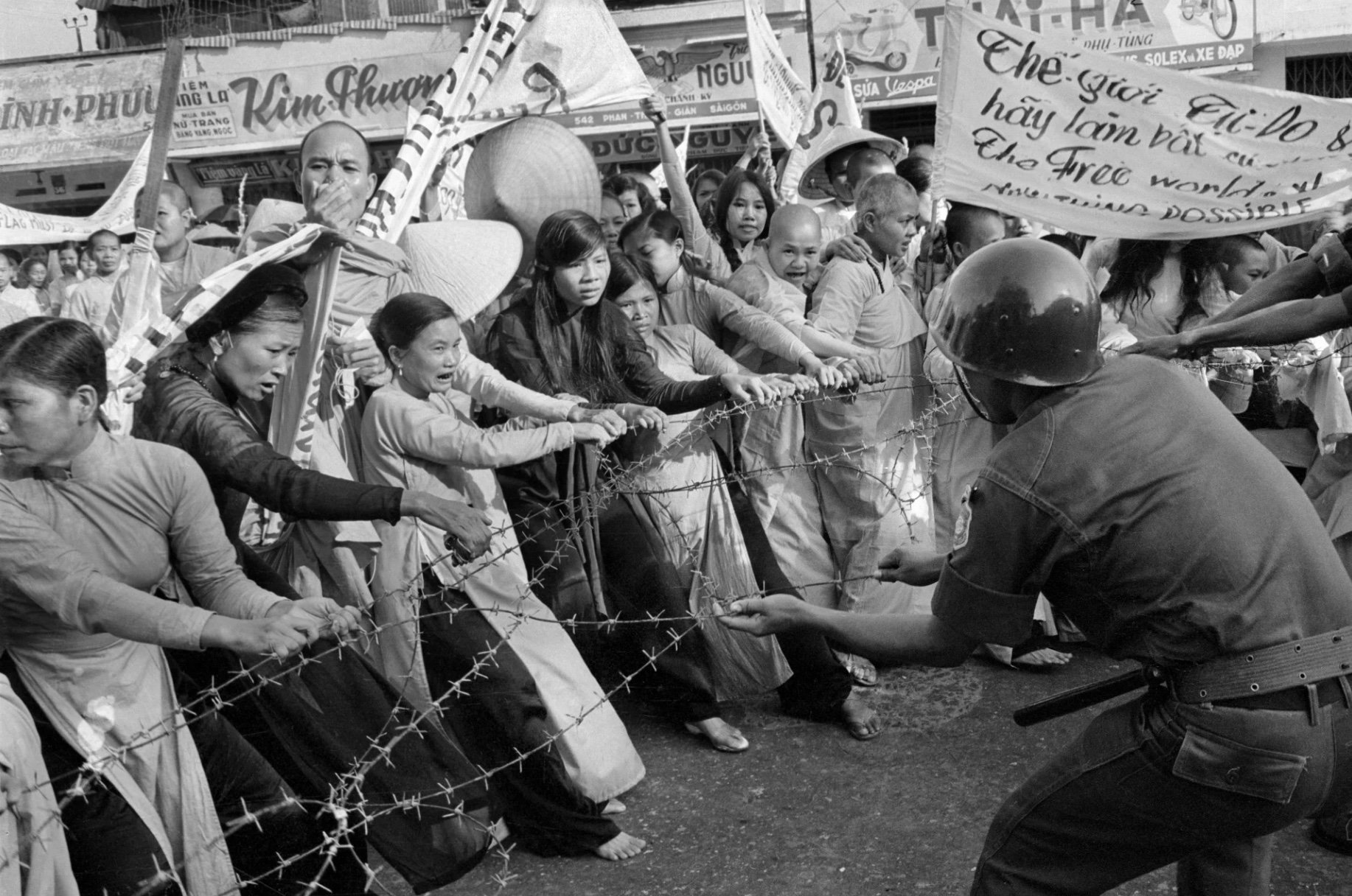
Buddhist protests, 1963
Buddhists began to protest in the strongest possible way, with a series of shocking self-immolations, including this famous image of the monk Thich Quang Duc setting fire to himself and dying on a Saigon street to protest persecution of Buddhists by the South Vietnamese government on 11 June 1963:

Thich Quang Duc’s self-immolation in Saigon, June 1963
What didn’t help was the response by the president’s sister in law and unofficial first lady, Tran Le Xuan, better known as Madame Nhu or “the Dragon Lady", dismissing such acts with perhaps the most insensitive political remark of all time (perhaps until the many more recently Donald Trump). “If the Buddhists wish to have another barbecue, I’ll gladly supply the gasoline and a match.”
JFK meanwhile was caught in a trap of his own making, despite declaring this on TV on 2 September 1963: “I don’t think that unless a greater effort is made by the government to win popular support that the war can be won out there. In the final analysis, it is their war. They are the ones who have to win it or lose it. We can help them, we can give them equipment, we can send our men out there as advisors, but they have to win it, the people of Vietnam, against the communists.”
On 22 November JFK was assassinated. America was wounded enough by that, and perhaps the new president, surrounded by hawkish, poor advisors, and bad military advice, felt compelled to accelerate win the war to win something his country. “We are not about to send American boys nine or ten thousand miles away from home to do what Asian boys ought to be doing for themselves,” he declared in 1964, but really that’s exactly what they were doing, and the Vietnam War was the beginning of white Americans widespread distrust in government.
Chief advisor Robert McNamara, a real architect of war involvement, also wrote in a memo to Johnson on May 19, 1967: “There may be a limit beyond which many Americans and much of the world will not permit the United States to go. The picture of the world’s greatest superpower killing or seriously injuring 1,000 non-combatants a week, while trying to pound a tiny, backward nation into submission on an issue whose merits are hotly disputed, is not a pretty one.”
But it just got worse and worse, from ousting and assassination of Ngô Đình Diệm, the Gulf of Tonkin incident, the Tet Offensive, all the way to the lingering, torturous conclusion the war, one, let’s not forget, America lost, and badly.
General William C. Westmoreland, the commander of all U.S. military forces in Vietnam, had regularly embarrassed himself with his bullish confidence:
“I am convinced that U.S. troops with their energy, mobility, and firepower can successfully take the fight to the NLF (Viet Cong),” he declared in 1964.
But in a speech to a joint session of Congress on 28 April, 1967, he admitted: “We are fighting a war with no front lines, since the enemy hides among the people, in the jungles and mountains, and uses covertly border areas of neutral countries. One cannot measure [our] progress by lines on a map.”
By then public opinion was turning and it is certainly in protest songs that much music may crop up this week. “Hey, Hey LBJ, How many kids did you kill today?” was one chant that first became popular in late 1967.
Associated Press correspondent Peter Arnett was one of the most reliable sources in a war mired in misinformation. He quoted a typically crazy remark by a US major on the decision to bomb and shell Ben Tre on February 7, 1968 after Viet Cong forces overran the city in the Mekong Delta forty-five miles south of Saigon during the Tet Offensive: “It became necessary to destroy the town to save it.”
Eventually Richard Nixon came to power. He didn’t exactly help either: “Let us understand: North Vietnam cannot defeat or humiliate the United States. Only Americans can do that.”he said on 3 November 1969.
"The bastards have never been bombed like they’re going to be bombed this time,” Nixon told his staff in 1972 when deciding to launch what would become known as Operation Linebacker, a massive escalation in the war effort that that included mining Haiphong Harbour, blockading the North Vietnamese coast, and launching a massive new bombing campaign against North Vietnam. Ten times as many bombs were dropped in Vietnam than in both World Wars combined. The consequences were devastating. In 1972 a South Vietnamese plane seeking Vietcong hiding places accidentally dropped its flaming napalm on civilians and government troops instead.
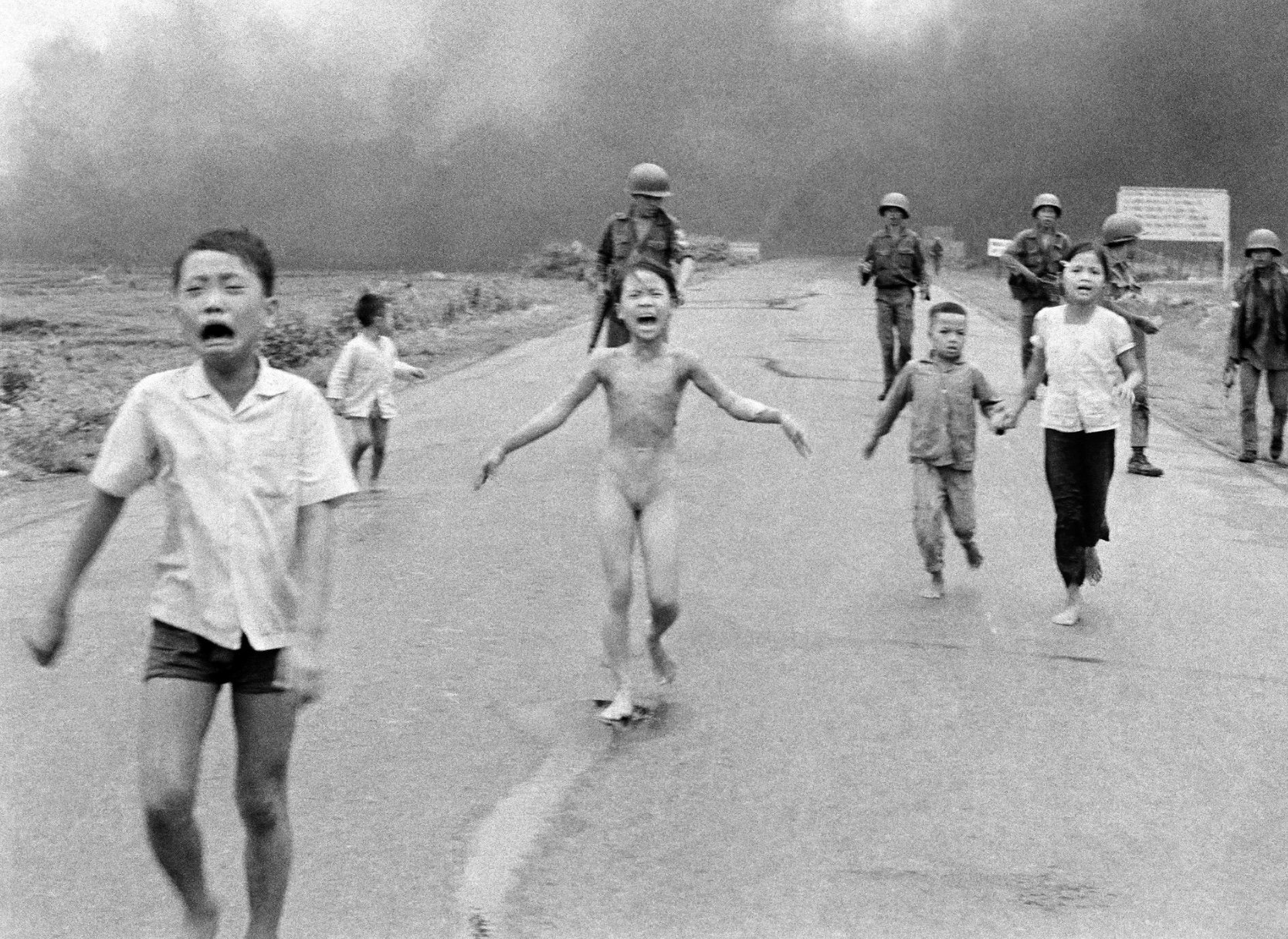
An image that burns through history: after a napalm attack children run screaming for help down Route 1 near Trang Bang
It all became untenable, especially after Watergate as well. Finally in President Gerald Ford’s statement arrived on 29 April 29, 1975:
“During the day on Monday, Washington time, the airport at Saigon came under persistent rocket as well as artillery fire and was effectively closed. The military situation in the area deteriorated rapidly. I therefore ordered the evacuation of all American personnel remaining in South Vietnam.”
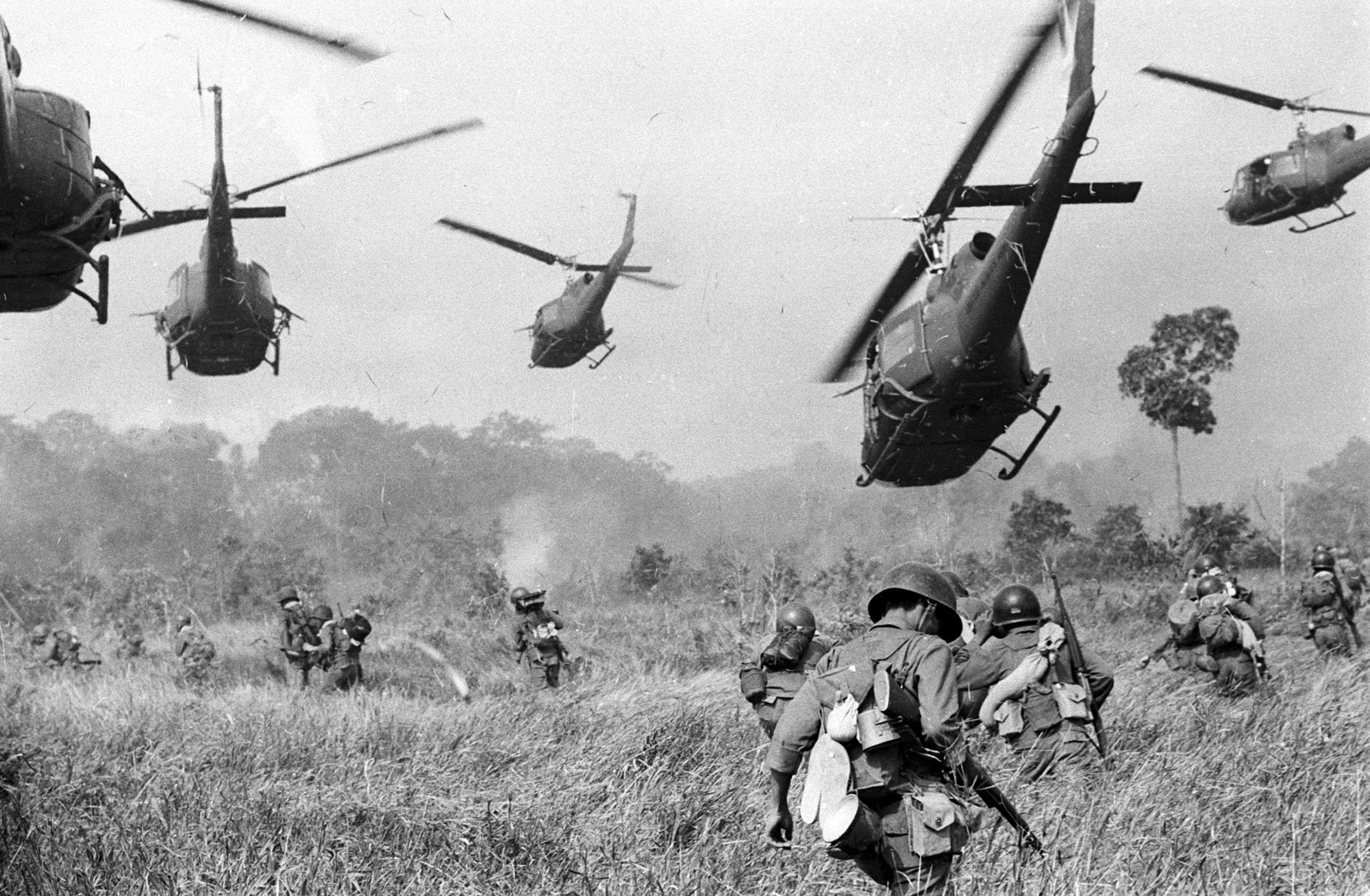
This is a mere choppy helicopter flyover of some of the quotes and events of the war. There are of course many great books, films, and documentaries, including a new Turning Point series currently available via Netflix.
On a musical perspective, South Vietnamese-born American professor and novelist Viet Thanh Nguyen writes in his book The Sympathizer about some of the lesser reported, harsh realities also faced by Black GIs who were pushed straight to the frontline. The story depicts the anonymous narrator, a North Vietnamese mole in the South Vietnamese army, who stays embedded in a South Vietnamese community in exile in the United States:
“Country music was the most segregated kind of music in America, where even whites played jazz and even blacks sang in the opera. Something like country music was what lynch mobs must have enjoyed while stringing up their black victims. Country music was not necessarily lynching music, but no other music could be imagined as lynching’s accompaniment. Beethoven’s Ninth was the opus for Nazis, concentration camp commanders, and possibly President Truman as he contemplated atomizing Hiroshima, classical music the refined score for the high-minded extermination of brutish hordes. Country music was set to the more humble beat of the red-blooded, bloodthirsty American heartland. It was for fear of being beaten to this beat that black soldiers avoided the Saigon bars where their white comrades kept the jukeboxes humming with Hank Williams and his kind, sonic signposts that said, in essence, No Niggers.”
There are many feature films about the subject, often very flawed and Hollywood. But with some veracity, of the better ones, there’s Oliver Stone’s series of three, culminating in the 1989 veteran film Born On the Fourth of July in which Tom Cruise plays real-life soldier-turned injured anti-war protester Ron Kovic. In 1987 there are also two that concentrate on the dehumanising training of tropps, Stanley Kubrick’s Full Metal Jacket, and the more comedic Robin Williams movie Good Morning Vietnam, about soldier radio DJ Adrian Cronauer.
But from the other side, there are several strong Vietnamese films, including The Little Girl of Hanoi, a North Vietnamese drama about the U. S. bombing of Hanoi in December 1972 based on the experiences of a 10-year-old girl, Ngoc Ha (Lan Huong):
But of course, it would be an oversight not to include mention of the fictional landmark, in Francis Ford Coppola’s 1979 Apocalypse Now, inspired by Joseph Conrad’s 1899 colonialism masterpiece, Heart of Darkness. Here then are two timeless clips, with two generals having lost the plot, but brilliantly portrayed. First, Lieutenant Colonel Bill Kilgore (Robert Duvall), getting his soldiers to surf his own perverse enjoyment of an infamous war chemical :
And of course Marlon Brando, as the renegade Special Forces officer, Colonel Kurtz, recounting the horrors of humanity:
So then, a few clicks in all directions and over and out to you, learned readers, for your Vietnam War-related songs. Commander-in-chief this week, ultimately bringing perspective and also peace to proceedings, is the marvellous musical map-reading strategist Loud Atlas! Place your suggestions in comments below by 11pm UK time, for playlists published next week.
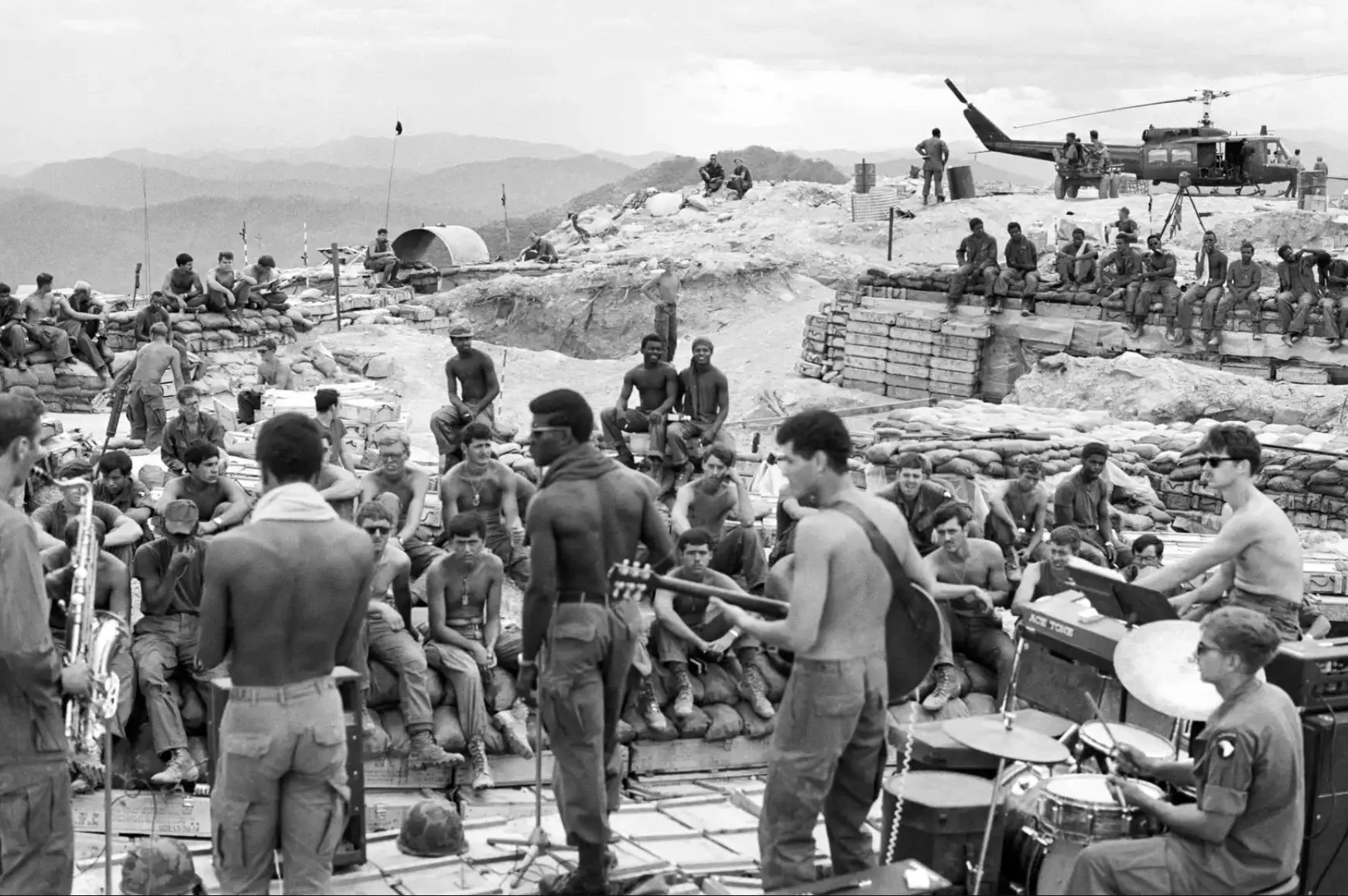
And still the band played on: GIs of the 3rd Brigade, 101st Airborne Division, launch into a rock session, 1970
New to comment? It is quick and easy. You just need to login to Disqus once. All is explained in About/FAQs ...
Fancy a turn behind the pumps at The Song Bar? Care to choose a playlist from songs nominated and write something about it? Then feel free to contact The Song Bar here, or try the usual email address. Also please follow us social media: Song Bar X, Song Bar Facebook. Song Bar YouTube, and Song Bar Instagram. Please subscribe, follow and share.
Song Bar is non-profit and is simply about sharing great music. We don’t do clickbait or advertisements. Please make any donation to help keep the Bar running.