
By The Landlord
“Higgins: Have you no morals, man?
Doolittle: [unabashed] Can't afford them, Governor. Neither could you if you was as poor as me.” – George Bernard Shaw, Pygmalion
"There is a working class – strong and happy – among both rich and poor: there is an idle class – weak, wicked, and miserable – among both rich and poor.” – John Ruskin
"Work is the curse of the drinking classes." – Oscar Wilde
"A working class hero is something to be." – John Lennon
"Your English society seems to me shallow, selfish, foolish. It has blinded its eyes, and stopped its ears. It lies like a leper in purple. It sits like a dead thing smeared with gold. It is all wrong, all wrong.” – Oscar Wilde, A Woman Of No Importance
“It is the most miserable thing to feel ashamed of home … I wanted to make Joe less ignorant and common, that he might be worthier of my society, and less open to Estella's reproach.”
– Charles Dickens, Great Expectations
You'd think, by now, it wouldn't be an issue. After all, we're no longer in Victorian times, where everybody knew their place and was expected to stay put. A time of stove pipe hats, of damp and fog, of wet brick, mills, and dangerous, dark city corners, of masters and servants, of anachronistic things such as vagrants, beggars, and poorhouses, where food donations were the only thing keeping children alive, or at the other end of the scale, extraordinary inherited privilege that set you up for life. Imagine such barbarian imbalance now! Surely, no such injustice exists today. We have moved on, there is no class, we are all fluid, socially mobile, and can become whoever we want, can’t we? Oh hang on ....
So what then is it about the issue of social status and mobility that with each generation, hovers over society like a swarm of flies? Why does it never go away? Why does it get people so animated, self-conscious and reactionary? Why do so many famous people, especially actors claim to have been working class? And how indeed do you define social class? Is it down to money and what you spend it on, or education, behaviour, values or all of these? Is it a peculiarity of British, as well as European culture? But what about the caste system in India and other parts of the far east that surely also erode over time in a changing modern world. Here’’s one rather basic summary of such a system:
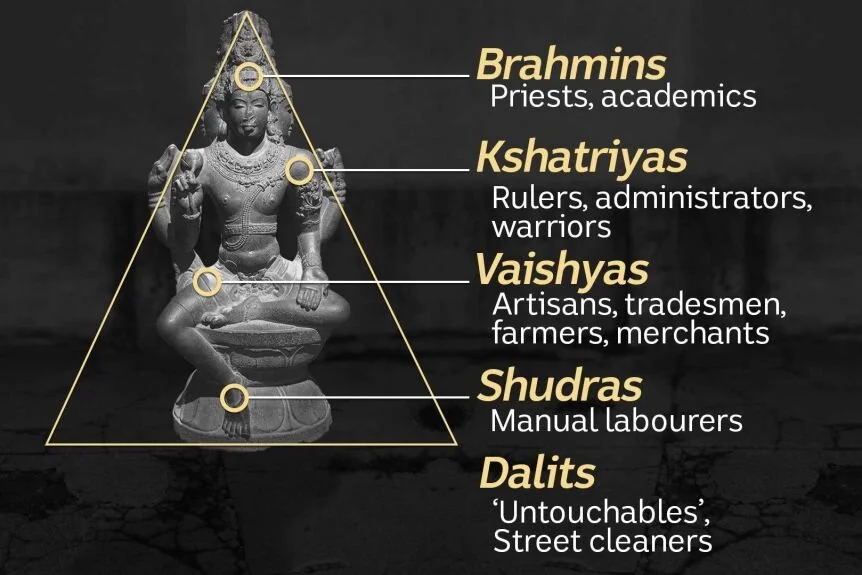
The traditional Hindu caste system
And isn't America a classless society, void of rigidity, being the land of the free where you can gain a new start, and can surely rise to attain your dreams? Social mobility, the possibilities, and just as much the lack of it, seem to fizzle up everywhere, and continue to do so, and are an especially potent topic for song. The emphasis is on social mobility, but class of course will certainly into it – the stories, the situations, and above all the feelings it generates.
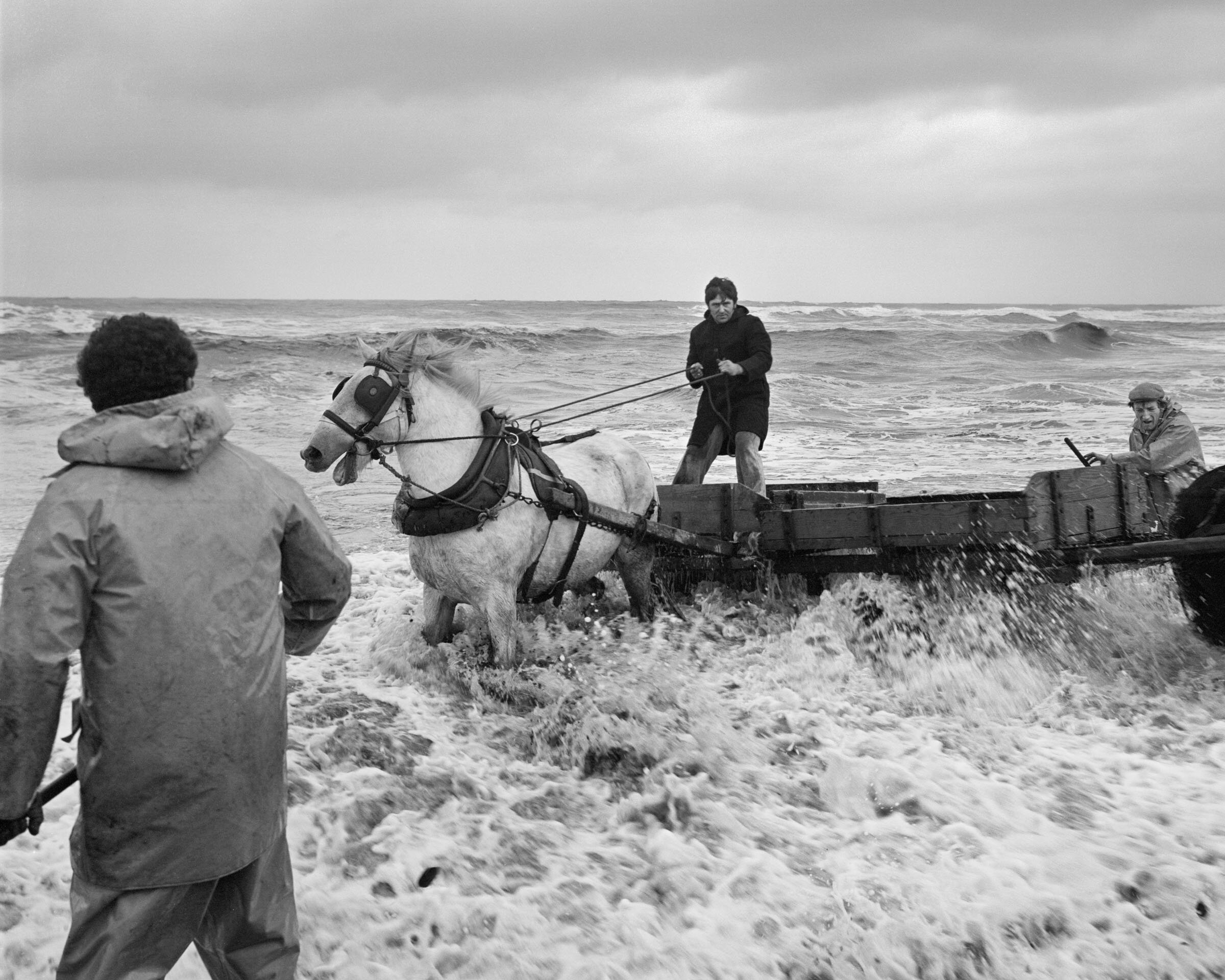
From Seacoal, a great collection of images of working class people in the north east of England the great photographer Chris Killip
Social class and mobility seems to me like some of the rules of quantum physics. They are really hard to understand, but more importantly, it exists, and yet it doesn't. It's in two places and none. It's both particle and wave. It's Schrödinger's cat – it's there and yet it's not. It seems to happen and then disappear again. My dad's side of the family traversed from working to middle class over a generation. My mum's side stayed where it was, and if anything slid down a little. It can move in two directions.
I was lucky enough to get a good education, armed with eccentric parents and an insatiable curiosity for words, people, and events. But I grew up in a Manchester street where, including the the kids I ran around with as a nipper, eventually the girls would generally get pregnant at 16 or work in shops, the lads take up factory jobs in the Trafford Park industrial estate, or more likely in the 1980s, sign on, and possibly in trouble with the law. When I got to university, even though I had a sense of it, I was still shocked at the level of privilege and sense of entitlement I witnessed. I was perceived by some, with my young man's caustic attitude and nasal accent, as working class, even though, simply by virtue of being there, I was obviously not. Anyway, many years later after lots of work and some smart and lucky moves, I now live in a street in London in a house full of music, art, and books, but just next door there's a bunch of bedsits, where a terrible lack of social mobility shows how history repeats itself. Money is useful, but education is really the key to moving on.
Social mobility and class is one of those topics that always throws up more questions than answers because society is in constant flux. In the 1980s Conservative prime minister Margaret Thatcher notoriously remarked that there was no such thing as society, claiming anyone could move up in the world and profit, just as she had done, hailing from a working-class Tory household. And yet it turned out to be more than a bit of a con. Social housing was reduced en mass with the so-called plan to encourage home ownership, except the result was that multiple homes were owned by wealthy individuals rather than everybody, and public utilities and transport privatised for the benefit for private shareholders, not the many who used them. So a few people rose up, but mostly, as the cliche goes, the rich got richer and the poor got poorer.
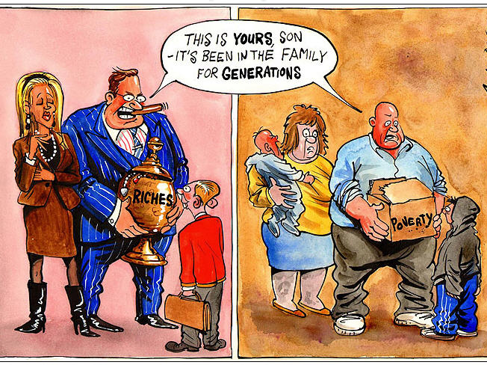
Here we go again …
And today, Boris Johnson's keeping the same minority group in business, while shitting on the many. The writing was always on the wall. In an article for the Daily Telegraph in 1995 he described "an appalling proliferation of single mothers.” The working class, in other words. And on the corresponding fathers he said: "If he is blue collar, he is likely to be drunk, criminal, aimless, feckless and hopeless, and perhaps claiming to suffer from low self-esteem brought on by unemployment. If he is white collar, he is likely to be little better.”
Surely though this Eton and Oxford educated prime minister would never act so irresponsibly as to father various children by different mothers like the feckless, lower classes he describes? Ahem. Class then is nothing to do with behaviour, it's more about what you're allowed to get away with.
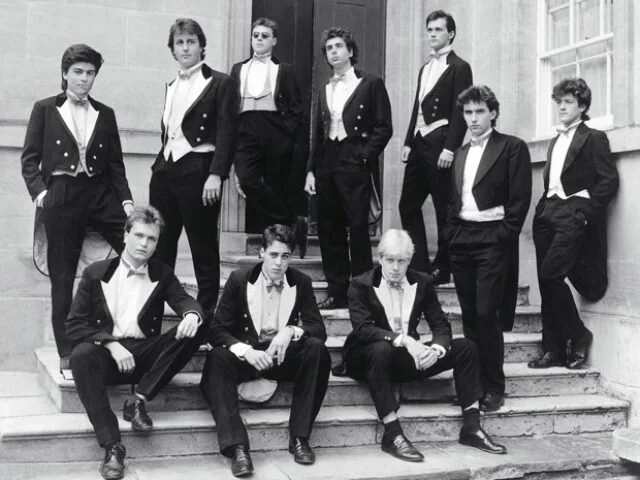
Oxford University’s notoriously privileged and backward Bullingdon Club, including here two Eton boys and future PMs - Boris Johnson, seated third from left, and David Cameron standing second from left
But enough about the Eton mess that has pretended to govern and protect the people of the UK for the last decade or more. When it comes to song, where does class and social mobility come into play, and whatever happened to working class bands? Are all pop musicians middle class now? Can only they afford to do it, and with a trust fund? If you can't afford a guitar and other equipment, what's the alternative? Is it really more realistic to aspire to be a footballer? Why is it that all the basics used to be cheap, and the luxuries expensive, but now it is vice versa? Has one generation pulled up the drawbridge on the ones who now follow it? Is there now less mobility than before, or more? And why are there so many questions in this introduction? Has society as a whole become more middle class? Or is it at both ends both posher and poorer? I still don't know the answers, but perhaps one daft way to answer this is by listening to the band Barry, and watching a puppet sing:
Social mobility has always been an aspiration and a subject for great storytelling, Few works capture it so richly as Charles Dickens novel written in 1860-61 which inspires the title of this introduction. Pip is an orphan brought up in a Kent village by his tough sister 20 years his senior, and her husband, the strong but gentle blacksmith Joe Gargery. That is Pip's life set out before him. But then he is invited to spend time at the wealthy house of the mysterious and twisted Miss Haversham, where he meets her apparent daughter, the cruel, snobbish but beautiful Estella. His values begin to shift, he aspires to move up in the world and join her clas, but can't, until, at the age of 18, he receives news of a mystery inheritance, money which enable him, as Mr Jaggers the solictor announces "to be immediately removed from his present sphere of life and from this place, to be brought up as a gentleman – in a word, as a young fellow of great expectations.”
Needless to say there are plenty of of twists and turns, where Pip experiences snobbery in London but fawning over his new wealth, his fortune to come not from, as expected, Miss Haversham, but from an escaped convict he had met in the graveyard as a child, and the posh Estella, his love obsession, to be the child of a common thief. It's still my favourite Dickens novel, full of wonderful characters showing the ups and downs of social mobility, of aspiration and disappointment, hope, comedy, kindness and tragedy.
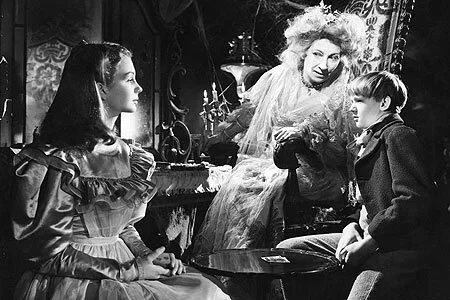
Estella, Pip and Miss Haversham in David Lean’s 1946 film adaptation
As Biddy, another orphan in the village, says to Pip of Estella: “Do you want to be a gentleman, to spite her or to gain her over?" Biddy quietly asked me, after a pause. "I don't know," I moodily answered.
“How could I, a poor dazed village lad, avoid that wonderful inconsistency into which the best and wisest of men fall every day?”
Pip’s biggest guilt comes with the embarrassment over his working-class but kind stepfather Joe, who sums up the class division wonderfully when he himself comes to London to visit and is uncomfortably dressed in a suit:
"Pip, dear old chap, life is made of ever so many partings welded together, as I may say, and one man’s a blacksmith, and one’s a whitesmith, and one’s a goldsmith, and one’s a coppersmith. Diwisions among such must come, and must be met as they come. If there’s been any fault at all to-day, it’s mine. You and me is not two figures to be together in London; nor yet anywheres else but what is private, and beknown, and understood among friends. It ain’t that I am proud, but that I want to be right, as you shall never see me no more in these clothes. I’m wrong in these clothes. I’m wrong out of the forge, the kitchen, or off th’ meshes. You won’t find half so much fault in me if you think me in forge dress, with my hammer in my hand, or even my pipe. And so God bless you, dear old Pip, old chap, God bless you!”
Joe knows his place in the world, and for that reason feels happier than Pip ever can.
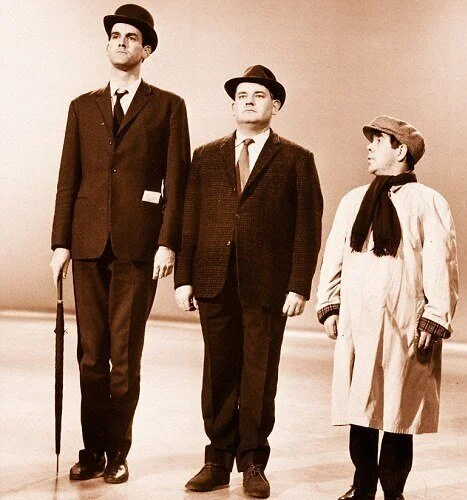
Perhaps though things were easier without social mobility, but as shown in this clip from The Frost Report in 1966 starring John Cleese, Ronnie Barker and Ronnie Corbett. Is this funny because it’s true, or because it was becoming no longer true? As ever, it’s both.
And then the two Ronnies reunited in 2000, now with Stephen Fry, with writer Barker, via the prism of class, sending up the idea of social progress through history
But social mobility isn’t easy and is rarely funny. As E.P. Thompson wrote in that classic work of history, The Making of the English Working Class, the industrial revolution that brought wealth and huge social change came at a massive cost.
“The process of industrialisation is necessarily painful. It must involve the erosion of traditional patterns of life. But it was carried through with exceptional violence in Britain. It was unrelieved by any sense of national participation in communal effort, such as is found in countries undergoing a national revolution. Its ideology was that of the masters alone. … But those who served it did not feel this to be so, any more than those ‘myriads’ who were served. The experience of immiseration came upon them in a hundred different forms; for the field labourer, the loss of his common rights and the vestiges of village democracy; for the artisan, the loss of his craftsman’s status; for the weaver, the loss of livelihood and of independence; for the child, the loss of work and play in the home; for many groups of workers whose real earnings improved, the loss of security, leisure and the deterioration of the urban environment.”
Social mobility and class is also about control. The 16th century Japanese commander Honda Masanobu wrote: “The peasant is the foundation of the state and must be governed with care. He must be allowed neither too much, nor too little, but just enough rice to live on and keep for seed in the following year. The remainder must be taken from him in tax.” Has much changed?
No one in the bottom rung of the social ladder actually wants to stay there of course. In The Road to Wigan Pier, George Orwell has an extraordinary passage describing, seeing from a train:
“At the back of one of the houses a young woman was kneeling on the stones, poking a stick up the leaden waste-pipe which ran from the sink inside and which I suppose was blocked. I had time to see everything about her—her sacking apron, her clumsy clogs, her arms reddened by the cold. She looked up as the train passed, and I was almost near enough to catch her eye. She had a round pale face, the usual exhausted face of the slum girl who is twenty-five and looks forty, thanks to miscarriages and drudgery; and it wore, for the second in which I saw it, the most desolate, hopeless expression I have ever-seen. It struck me then that we are mistaken when we say that ‘It isn’t the same for them as it would be for us,’ and that people bred in the slums can imagine nothing but the slums. For what I saw in her face was not the ignorant suffering of an animal. She knew well enough what was happening to her—understood as well as I did how dreadful a destiny it was to be kneeling there in the bitter cold, on the slimy stones of a slum backyard, poking a stick up a foul drain-pipe.”
As the film-maker from Flint, Michigan, Michael Moore, puts it: “One of the basic tenets of the working class is you want to get out of the working class.”
But hat about in America? Robert Reich, the economist, writer and former government adviser says: “We used to be so proud that our country offered far more economic opportunities than the feudal system in Great Britain, with its royal family, princesses and dukes. But social mobility in the UK is higher than in the US. Our social rift is as big as it was in the 1920s.”
And from a performer perspective, here’s Anohni on the subject: “The top end are still making bucket loads while maintaining the illusion of the American dream: that if you work hard enough, you can make a fortune. Meanwhile, the working and middle classes have been hollowed out of the system.”
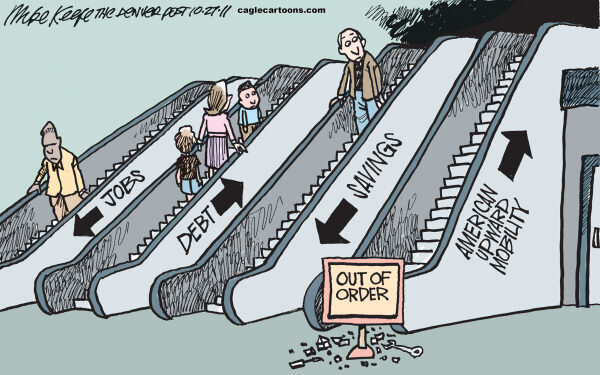
Social mobility is currently out of order
The same thing very much happened in sport. As Eric Cantona put it: “The real fans of football come from the working class. Now they cannot afford to come and watch the game.”
Film too a huge source of inspiration for the portrayal of social class and mobility. As well as David Lean’s adaptation of Charles Dickens, there’s 1964’s My Fair Lady, adapted from George Bernard Shaw's 1913 stage play Pygmalion starring Audrey Hepburn as the working class flower seller Liza Doolittle and Rex Harrison as the professor Henry Higgins who tries to teach her to become upper class. It’s a dodgy idea in many ways, Harrison’s character’s arrogance and snobbery, as well as the values of the film being fundamentally very sexist and saccharine, but also the source of great humour and social values. Here’s Liza at the races, first engaging in some high society conversation:
And then getting excited over a horse:
In a film with a very different tone, and from the book that inspired it, Agent Starling in Thomas Harris’s Silence of the Lambs comes from a poor, working-class background, a nuance the cannibal and frighteningly perceptive Dr Lector is keen to comprehend:
“Starling knew what the malicious Dr. Lecter would say, and it was true: she was afraid there was something tacky that Senator Martin saw in her, something cheap, something thief-like that Senator Martin reacted to. That Vanderbilt bitch. Dr. Lecter would relish pointing out that class resentment, the buried anger that comes with mother's milk, was a factor too. Starling gave away nothing to any Martin in education, intelligence, drive, and certainly physical appearance, but still it was there and she knew it.”
Other great portrayals of larger social mobility, or lack of it, include the servants and the served in the wealthy manor house and incredible cast of Robert Altman’s Gosford Park, and more recently Alfonso Cuarón’s 2018 masterpiece, Roma, about a housekeeper in a middle-class family in 1970. Then there’s Bong Joon-ho’s brilliant Parasite, the black comedy about a poor family who try to exploit a wealthy household, and the same director’s 2013, Snowpiercer, now also a TV series, a futuristic setting of the last survivors on a frozen future Earth who live on a 1,000-carriage train traversing the globe to generate electricity to survive, on which there is a clearly defined class system of 1st to tail, the latter living off scraps, and eager to fight their way up the chain.
Is social class always accurately portrayed in film? Not according to Michael Caine, who tells us: The American cinema in general always made stories about working-class people; the British rarely did. Any person with my working-class background would be a villain or a comic cipher, usually badly played, and with a rotten accent. There weren't a lot of guys in England for me to look up to.”
But the great director of working class characters in Britain, Ken Loach is also here: “I challenge the idea that films about rich people are escapism and films about working class people are dour and sad. I find the opposite's the case.”
The best understanding of class mobility is by those who have experienced contrast, by having by being from or of spending significant time with different spheres of society, not just your own circle. As David Bowie put it: “I went to a middle-class school, but my background is working class. I got the best of both worlds, I saw both classes, so I have a pretty fair idea of how people live and why they do it.”
But for me the most profound and moving short film about class mobility is this from last year, where a bunch of American kids are asked to take part in a race for a $100 dollar bill. But first the distances from the prize are mapped out by what social advantages each are born with. It really is a must-watch:
So that leads us to some music to start the ball rolling, here’s a couple of examples. The first, most obvious perhaps is about that sharp social observer Jarvis Cocker’s experience of going to art school, and was previously chosen, for some reason for another topic. But it’s still up for grabs for the B-list.
And, in a reverse perspective, inspired by Monty Python and sending up how the privileged classes fear downward mobility, and are terrified of immigrants and those below them, those clever rapscallions Fat White Family and Tastes Good With The Money, from the album Serf’s Up, with a video directed by Róisín Murphy, and a lovely coda by Baxter Dury, son of the great poet geezer Ian, and that distinctive voice that traverses class definition.
So then, from posh country houses to tenements and beyond, it’s time to turn the issue over to you. Head of the class, and taking in your nominations, I’m delighted to welcome back to our wonderful Bar where all backgrounds are welcome, the superb Suzi! Deadline for nominations is Monday at 11pm UK time, for playlists published on Wednesday. The response, and the results, no doubt, will be pure class.
New to comment? It is quick and easy. You just need to login to Disqus once. All is explained in About/FAQs ...
Fancy a turn behind the pumps at The Song Bar? Care to choose a playlist from songs nominated and write something about it? Then feel free to contact The Song Bar here, or try the usual email address. Also please follow us social media: Song Bar Twitter, Song Bar Facebook. Song Bar YouTube. Subscribe, follow and share.
Please make any donation to help keep Song Bar running: