
By The Landlord
“I don't play a lot of fancy guitar. I don't want to play it. The kind of guitar I want to play is mean, mean licks.” – John Lee Hooker
“In a lot of Led Zeppelin, the riff was the juggernaut that careered through and I worked the lyrics around this.” – Robert Plant
“The first song that made me interested in music was 'Oh, Pretty Woman' by Roy Orbison. It was the guitar intro, that riff, that I really liked and made me listen in a different way.” – Geddy Lee
“The hook of the riff is what makes a great guitar recording. It's the backbone of the whole song. When you have a strong riff, it's the rocket fuel for the track.” — Dwight Yoakam
“When I write a song, it's all about the riff - the riff first, then the words come later.” – Evan Dando
“Generally my songs are just some riffs slung together as an excuse for a guitar solo.” – J Mascis
Now we’re just over a quarter through this century, arguably it’s a period in history defined most of all by great rifts. But this week it’s not the occasion to dwell on that, instead, with the difference of one small letter, to play on something far positive, tuneful and upbeat. As Chuck Berry, that master of the guitar riff in the previous century, such as with Johnny B Goode, put it: “Music should be made to make people forget their problems, if only for a short while.”
We can hopefully all recognise what a great riff sounds like – it’s defined as a short, repeated musical motif or figure, and it’s often not the main sung melody, but instrumental, accompanying and complementary, though very much an integral part of a song or piece of music – and all great riffs are just as memorable and catchy. Newcastle University’s Professor of Music Richard Middleton and author on several studies of pop music defines riffs as "short rhythmic, melodic, or harmonic figures repeated to form a structural framework”.
The other perhaps obvious point is that the riff isn’t a big solo. It’s the core part of the song, not the flashy breakout, and it’s our ears that are the instrument to catch and identify this shiny musical fish.
It’s always easier and clearer to explain by example. It’s now more than 60 years since the release of the Rolling Stones’ (I Can’t Get No) Satisfaction, in which Keith Richards, who learned so much by listening to Chuck Berry, created an opening guitar riff that’s arguably a far bigger feature in the song that Mick Jagger’s sung melody. What makes it great is it’s perhaps of all Stones songs, it’s the tune you’ll likely hum first.
Meanwhile though here’s a clip of master and pupil, with Chuck showing Keith how to “get it right”:
For me, the great riffs aren’t just catchy – they speak to you. They are played as if voicing words with some universal meaning that grammatical somehow, but also international – played with intonation and sometimes as if the instrument takes a short breath between phrases. Perhaps that’s why they become wonderful earworms to us.
Many riff suggestions this week might well be played on the guitar, as that’s the instrument used by many songwriters, but they could be played on any variety of instruments – bass, piano, synths, violin, brass or anything else. Stevie Wonder, for example, wrote many of his fabulous riffs on keyboards of course and Ray Charles in turn was among his influences.
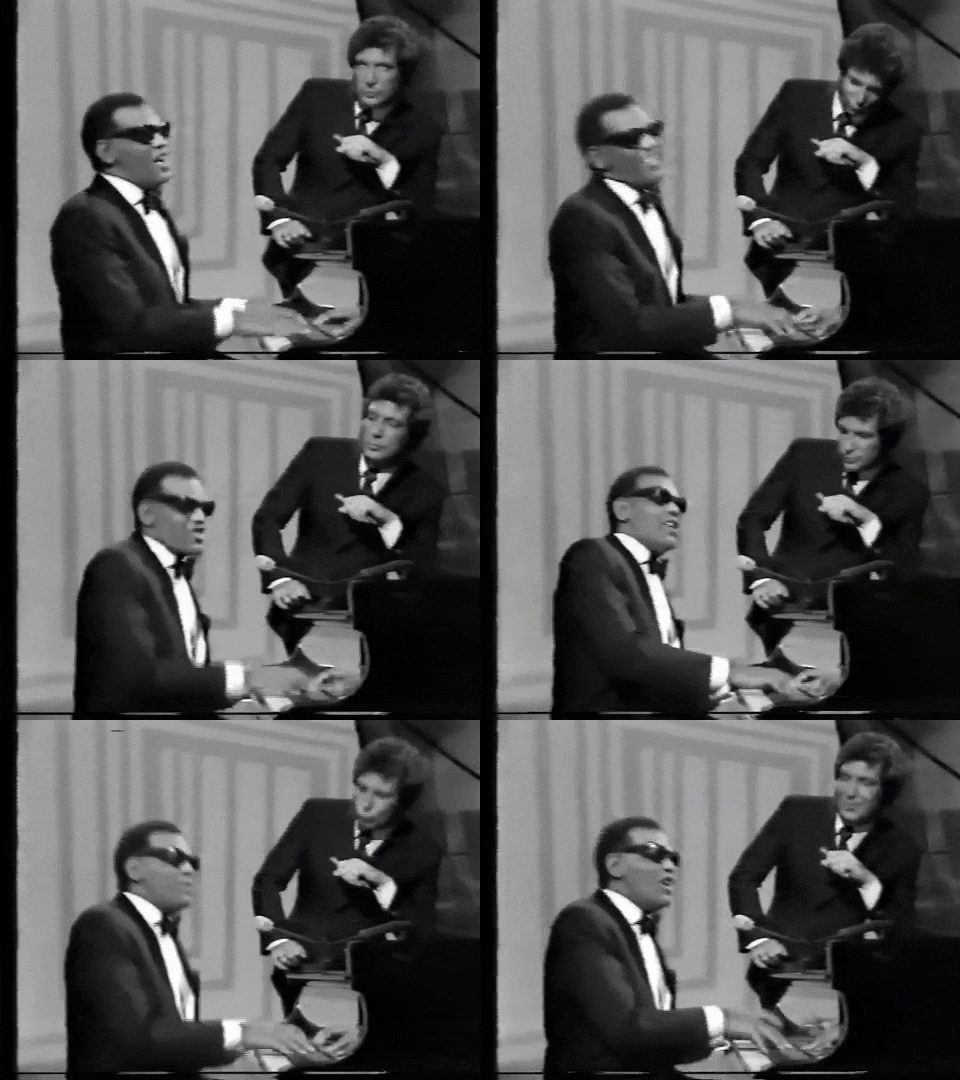
Ray Charles shows Tom Jones how its done
The etymology of the word riff is unclear – it entered the language in the 1920s, often in the context of jazz from which those motifs were improvised, but riffs had been used extensively in classical music for centuries before. In the documentary A World Without Beethoven (and that famous German composer was no slouch himself when it came to creating great riffs and then extemporising with them), Jethro Tull’s Ian Anderson states that riff is simply short for "repeated motif”, but others argue could also be an abbreviation for ”rhythmic figure", "rhythm fragment", or “refrain”. They all describe elements of the riff.
A riff form has a few related terms such as vamp, in which a chord or chords are repeated in a rhythmic pattern, often used in jazz and funk. And there’s ostinato, from the Italian 'stubborn', like the English obstinate) is a musical motif or phrase that persistently repeats in frequently in the same pitch, such as on famous classic pieces such as Ravel’s Bolero, or on the disco floor Donna Summer and Giorgio Moroder's I Feel Love, Henry Mancini's theme from Peter Gunn or The Pink Panther and The Who's Baba O'Riley, and Radiohead’s Creep. Lick, hook, vamp, ostinato? They all count as riffs for the purposes of this topic. A variety of genre, including film music, should also come into the frame.
There are a few other guest riffing on their guitars in the Bar this week.
Brian Wilson is tinkering on our piano and tells us how it all got started with his process. “I would listen to Little Richard and Fats Domino and Chuck Berry, and I would listen to how they played their riffs, and after I taught myself that, I taught myself to play my own kind of stuff.”
Dick Dale is revving up his guitar and might be in danger of blowing our amplifiers with that most famous version of Misirlou and that jangling riff. He’s also a little bit too obsessed that an even more famous guitarist was heavily influenced by him in the early days: “Hendrix was the bass player for Little Richard. We were both left-handed, but we would use a right-handed guitar held upside down and backwards. He developed my slides and my riffs. In fact he used to say, and this is documented, 'I patterned my style after Dick Dale.’”
Angus Young of AC/DC reveals how one of his most famous had been kicking around for quite a while before finally appearing in a song: “Riffs are a repeating thing. They come back to you. Some of the things on Back in Black were ideas we had knocked around on tracks before that: 'That bit - maybe we should take a chunk of that and slug it in here.’”
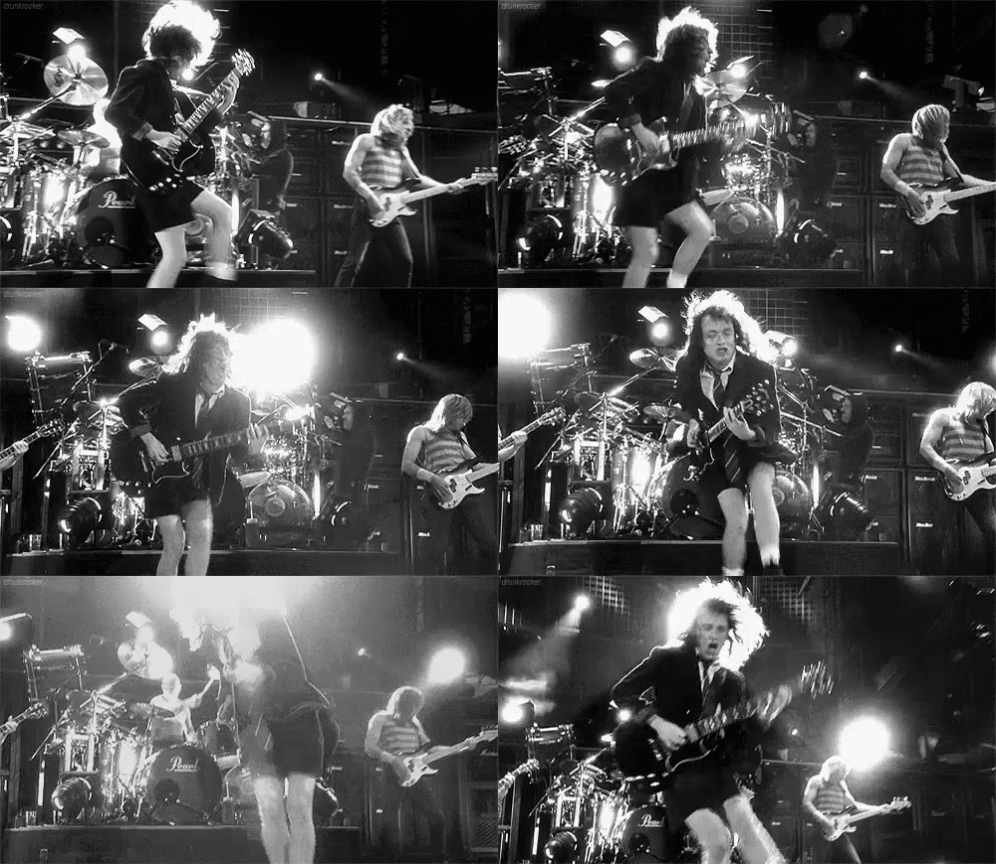
Angus!
And here’s guitarist Richard Lloyd (founding member of Television), who enjoys a special kind of riff: “To me, the coolest riffs are composed of two guitar parts that interlock like gears. You need both parts to make whole. I work things out on an electric that's not plugged in to make sure a good tone isn't forgiving a part that couldn't stand up naked. Only after the parts are written will I struggle to find a tone that supports the creativity.”
So the 20th century brought many great examples, from The Kink’s You Really Got Me to Led Zeppelin’s Whole Lotta Love and Black Dog to Deep Purple’s Smoke On The Water, Fleetwood Mac’s The Chain, Stevie Wonder’s Superstition to Chic’s Good Times, Television’s Marquee Moon to The Cure’s Boys Don’t Cry, The Stone Roses’s Fools Gold to Beck’s Loser and Blur’s Song 2. But what those that catch you released the new century?
Over to you then, and this week’s sharp ears eager to catch the hook is the excellent riffmaestro ajostu! Place you suggestions, ideally identifying entry point of the riff, and who is playing it, in the comments boxes below, for deadline at 11pm UK tie, for playlists published next week.
New to comment? It is quick and easy. You just need to login to Disqus once. All is explained in About/FAQs ...
Fancy a turn behind the pumps at The Song Bar? Care to choose a playlist from songs nominated and write something about it? Then feel free to contact The Song Bar here, or try the usual email address. Also please follow us social media: Song Bar X, Song Bar Facebook. Song Bar YouTube, and Song Bar Instagram. Please subscribe, follow and share.
Song Bar is non-profit and is simply about sharing great music. We don’t do clickbait or advertisements. Please make any donation to help keep the Bar running.