By The Landlord
“In order to understand the history of the banjo, and the history of bluegrass music, we need to move beyond the narrative we've inherited, beyond generalizations that bluegrass is mostly derived from a Scotch-Irish tradition with influences from Africa. It is actually a complex Creole music that comes from multiple cultures.” – Rhiannon Giddens
“This machine surrounds hate and forces it to surrender.” — Pete Seeger
“When I got out of school, I spent two years just hitchhiking around. Every time I met some old farmer who could play banjo, I got him to teach me a lick or two. Little by little, I put it together.” – Pete Seeger
"A banjo will get you through times of no money, better than money will get you through times of no banjo." — John Hartford
"A gentleman is someone who knows how to play the banjo and doesn't." – Mark Twain
“The banjo is truly an American instrument, and it captures something about our past.” – Steve Martin
“They think the banjo can only be happy, but that's not true.” – Béla Fleck
“I went to my room and packed a change of clothes, got my banjo, and started walking down the road. Soon I found myself on the open highway headed east.” –Burl Ives
“What is the least often heard sentence in the English language? That would be: Say, isn't that the banjo player's Porsche parked outside?” – Jackson Browne
“If I have something inside me that I want to get out, I'll just beat it out on the banjo right then and there.” – Valerie June
It has a distinctively flavoursome, often fast-finger twang, resonant in some surprising notes through history. And those echoes and associations come long before the likes of the theme fromThe Beverly Hillbillies or the cross-eyed duelling tensions of Deliverance, or white Appalachian and other folk traditions, or over in Scotland or Ireland, but from much further afield, far up and down river, emanating along centuries, brought across oceans, via creole, Haiti and New Orleans, via jazz, blues, with its origins over the African continent. The banjo began as a reverberant gourd strung with a long stick, played with fingers and thumb, strummed and plucked with drone and melody, and the sound goes way back, expressing thousands of stories of slavery, exploitation, suppression, appropriation, survival, endurance and reinvention.
This week, then, it's an instrument likely to span all kinds of songs and genres since sound was first recorded, wherever the banjo is prominent in sound or featured in solo. Its more primitive versions may originally have come from Mesopotamia via Egypt, but it any recognisable form emanates from West and Central Africa, with a first written description by Richard Jobson in 1621 about The Gambia, noting music played and heard:
"They have little varietie of instruments, that which is most common in use, is made of a great gourd, and a necke thereunto fastned, resembling, in some sort, our Bandora; but they have no manner of fret, and the strings they are either such as the place yeeldes or their invention can attaine to make, being very unapt to yeeld a sweete and musicall sound, notwithstanding with pinnes they winde and bring to agree in tunable notes, having not above sixe strings upon their greatest instrument."
The name has ambiguous origins. It could come from the Mandinka language and Banjul, capital of The Gambia, the African akonting instrument made from a long bamboo neck called a bangoe, the Kimbundu word mbanza, or dialectal pronunciation of Portuguese bandore or from an early anglicisation of Spanish bandurria. There are many theories. Either way, when slaves from different parts of Africa were banded together on ships and into fields, remnants of their culture came along too, including songs and instruments, African spike lutes such as the ngoni, a gourd with a stretched animal string, or the West African xalam which also has 1 to 5 strings. Eventually the banjo emerged, with 4 to 6 strings, some with a bottom, shorter drone string played with the thumb, and that distinctive round, resonant shape, the long, fretted neck.
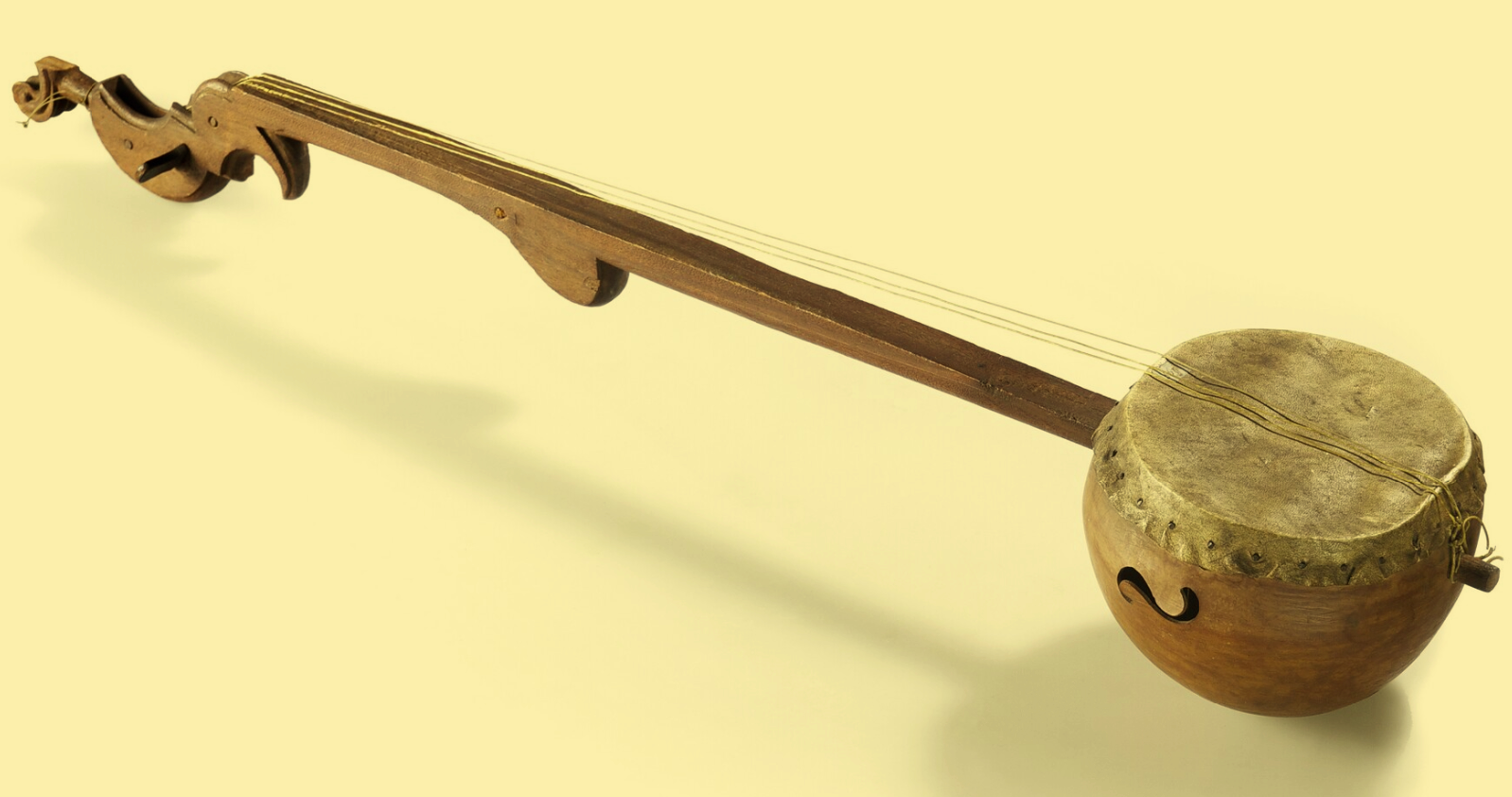
The oldest extant banjo, c. 1770–1777, from Surnamese Creole culture
Looping back then through time and geography, great Malians such as ngoni player Bassekou Kouyate and kora master Toumani Diabaté use very similar finger-picking techniques as modern banjo instrument players. Twenty years ago, white American counterpart Béla Fleck, an American virtuoso banjo player who blends jazz and bluegrass, and who was brought up on and inspired by the the skills of Earl Scruggs, made a move to try to end the strictly deep south an mountain white-folk associations of the instrument by visiting Africa to jam with musicians who played in a similar way. It brought about two albums and the documentary film Throw Down Your Heart:
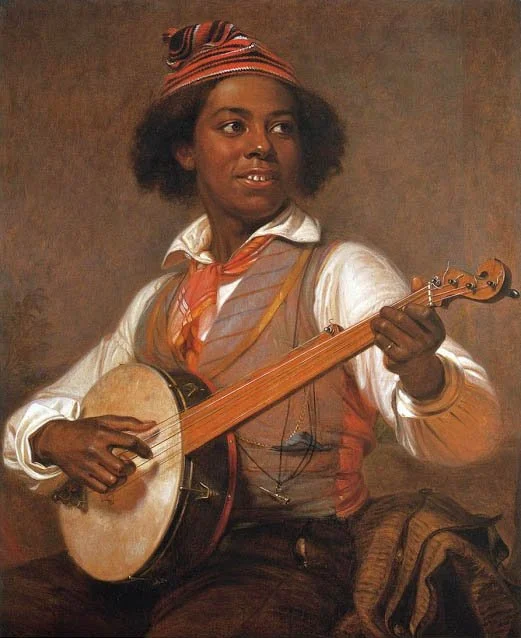
Nevertheless, the banjo as we know it, with frets and metal strings and that resonant round body, is very much an instrument of the Americas, central, north and south, created from a melting pot out of slavery, a fusion of Haitians into New Orleans, with dancing and music Congo Square as epicentre, and banjo players were primarily black until the early 19th century.
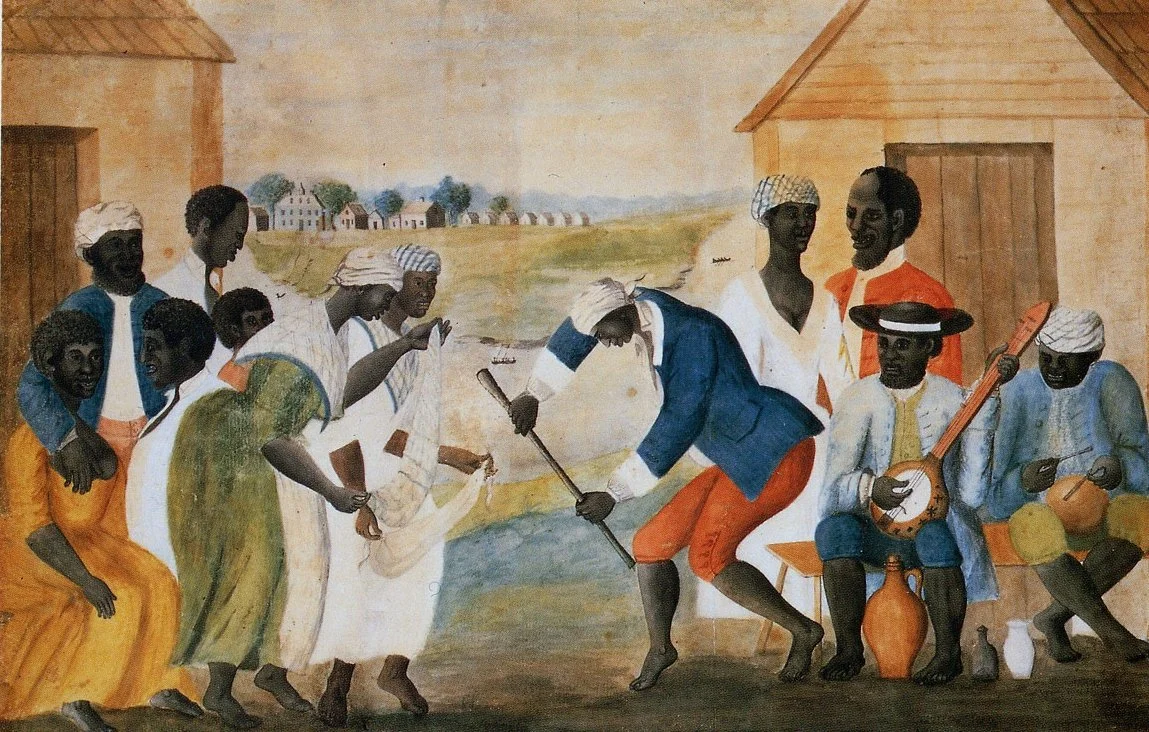
The Old Plantation, c. 1785–1795, thought to be in Beaufort County, South Carolina, and the earliest known American painting to picture a banjo-like instrument, which shows a four-string instrument and the thumb string shorter than the others
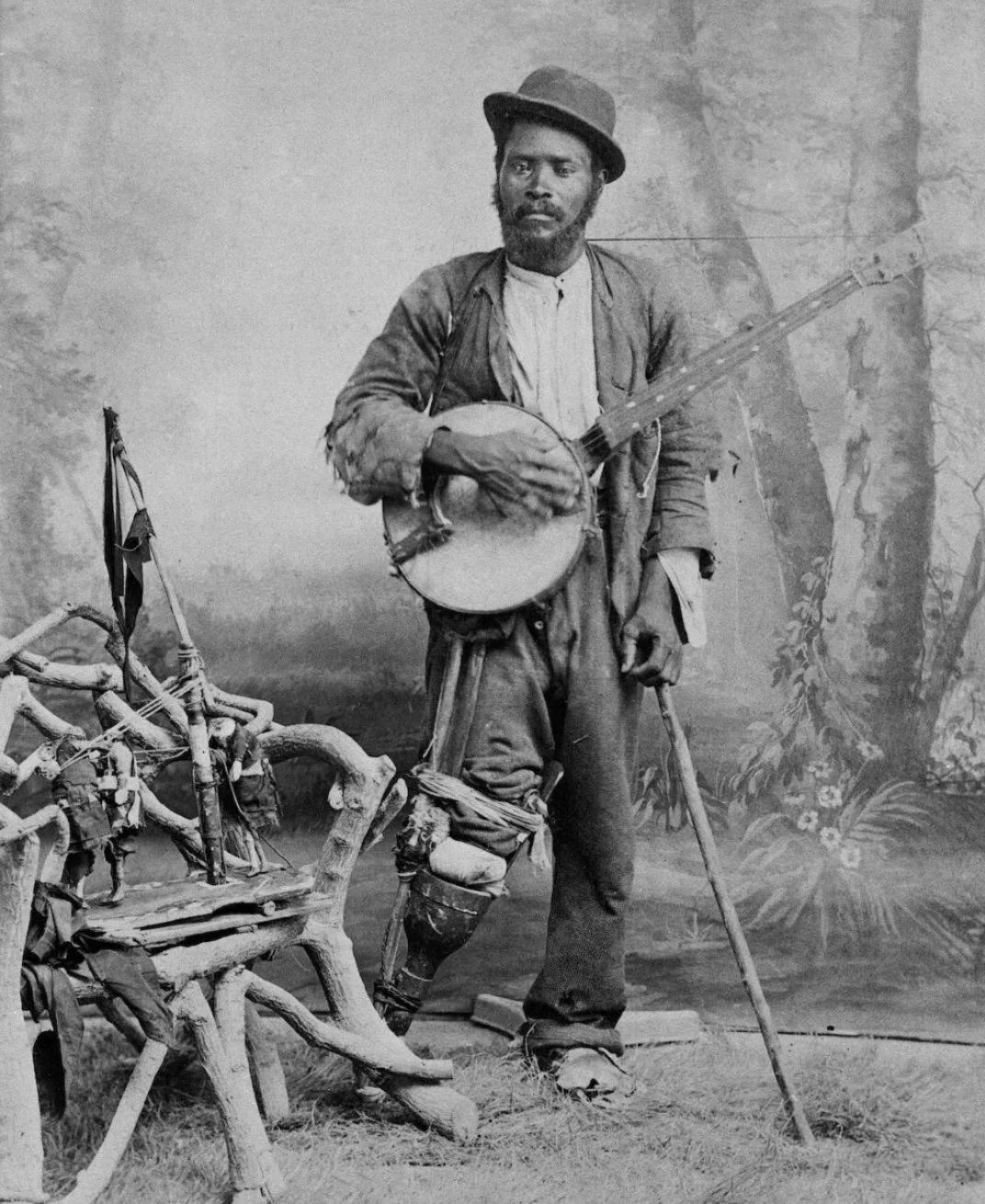
A disabled player with the scoop necked banjo, 1850s
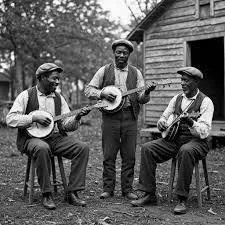
From the south, the instrument spread rapidly when merchandise and personnel travelled on boats moving in different directions, resonant across water, and far fast then when remaining on plantations. It quickly began to spark a much wider interest and manufacture began to bloom. Suddenly there were banjo orchestras all over. Banjos featured in European quadrille dances. There were all-female clubs and groups.
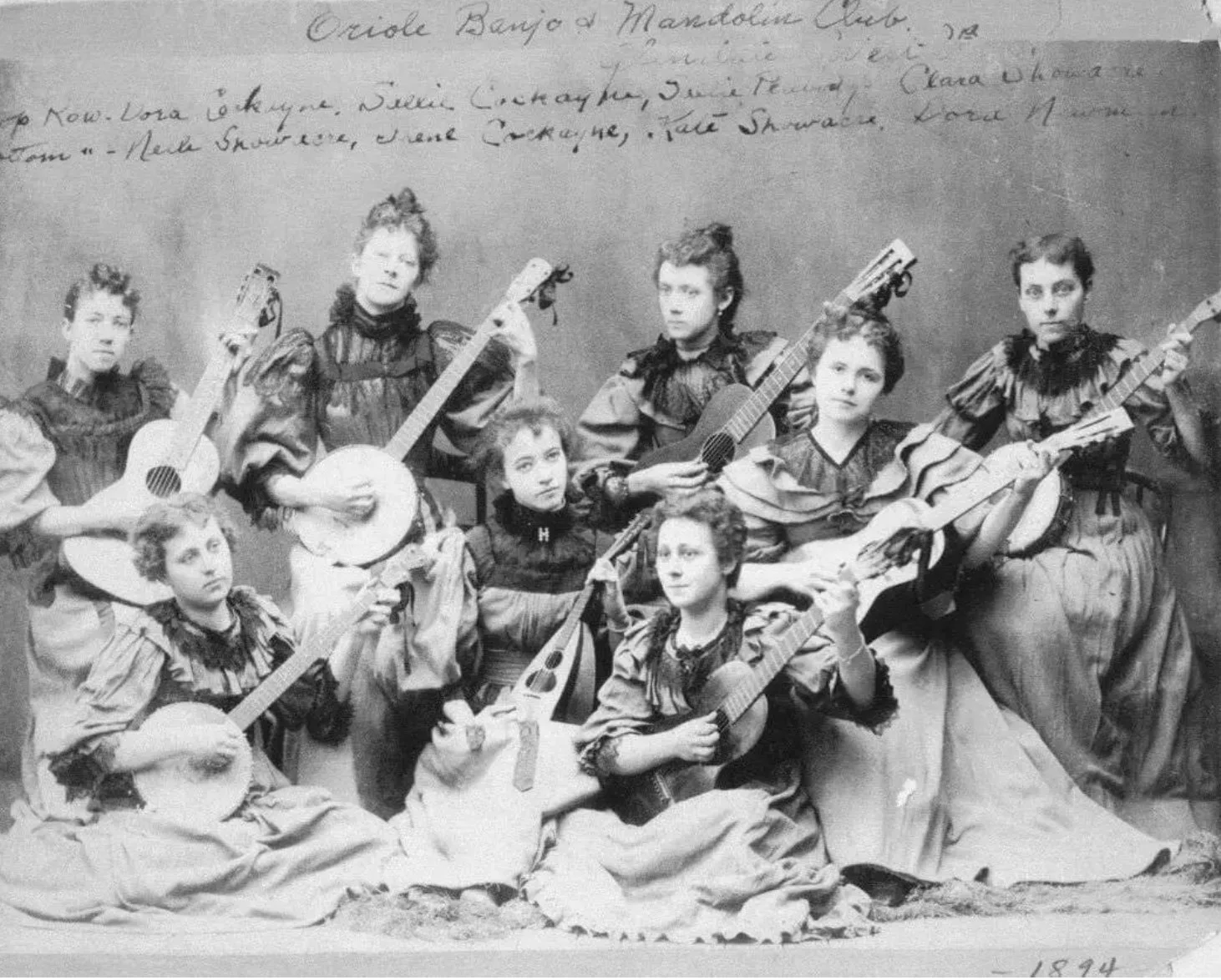
White creole banjo and mandolin club, 1894
But while creole music continued in New Orleans, including a banjo-playing precursor to reggae, the banjo was gradually appropriated by America's white culture. Minstrel shows, at their peak from the 1830s to the1870s, but lasting far long, had white musicians blacking up were common, with popular numbers such as Dandy Jim from Caroline, featuring white player Dan Emmett and the other Virginia Minstrels.
The Jim Crow culture took over. Instead of listening to African Americans playing to learn the songs, they were written down and published to bypass and increase segregation and stereotyping.
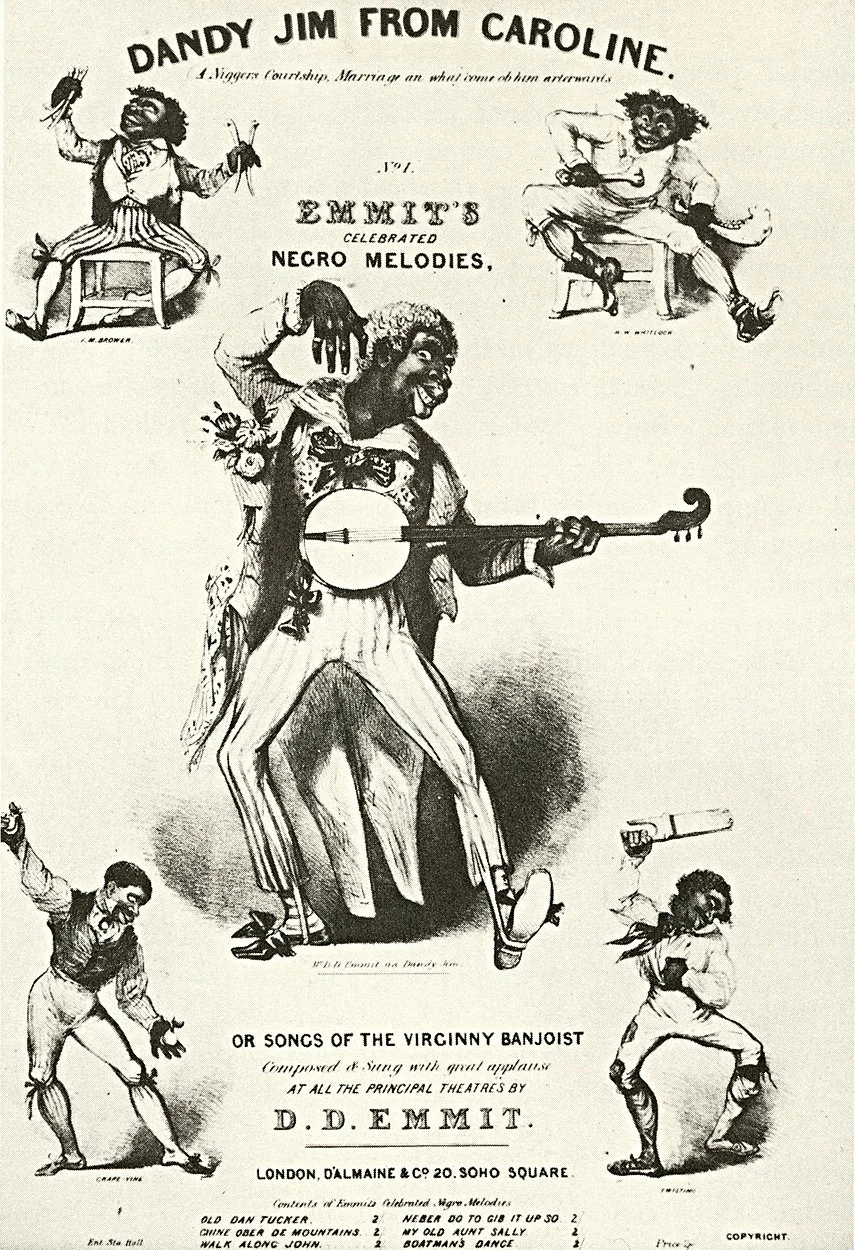
Racially stereotyped minstrel show sheet music: Dandy Jim From Carline, played by white, blackface performer Dan Emmett (centre), with other Virginia Minstrels, 1844
It also gave rise to other ensembles such as this in the 1920s:
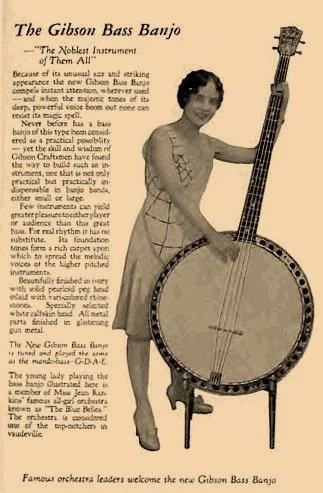
Gibson bass banjo, 1930s
With jazz, swing and ragtime, the banjo developed, with the five-string model since 1830s and newer four-string plectrum and tenor banjos. There were even giant models.
The banjo had been very popular because it was loud, and could be heard in acoustic settings. But as microphone and the electric guitar developed, it began to recede from popularity.
Nevertheless this week's topic should unearth all sorts of gems across the genres, not merely those mentioned, but also various forms of folk and bluegrass, rock and pop, hip-hop, classical, reggae and more. There have been many brilliant players from Earl Scruggs to Pete Seeger to Béla Fleck, Celtic folk music's Gerry O'Connor, jazz's Perry Bechtel and those reclaiming their ancestry, the multi-genre players Otis Taylor, and more recently Rhiannon Giddens, Valerie June, and the self-described "Chinese-speaking, banjo-picking girl. Abigail Washburn.
Finally here's an informative film connecting cultures and including Rhiannon Giddens who has multiracial ancestry, talking about the banjo’s place in American history, and with a special instrument from banjo maker Jim Hartel:
So then, what will be your picks for this instrument, and will they resonate? And who will possibly take the chair and pluck them out for resulting playlists? It’s that highly perceptive, hot picker Uncleben! Place your ideas in comments below for the deadline at 11pm on Monday UK time, for playlists published next week.
New to comment? It is quick and easy. You just need to login to Disqus once. All is explained in About/FAQs ...
Fancy a turn behind the pumps at The Song Bar? Care to choose a playlist from songs nominated and write something about it? Then feel free to contact The Song Bar here, or try the usual email address. Also please follow us social media: Song Bar X, Song Bar Facebook. Song Bar YouTube, and Song Bar Instagram. Please subscribe, follow and share.
Song Bar is non-profit and is simply about sharing great music. We don’t do clickbait or advertisements. Please make any donation to help keep the Bar running.